


What is a force?
A force is a push or pull arising from an interaction. Forces can change an object’s motion when their combined effect is not balanced.
Connect Newton’s laws with everyday motion through illustrated questions and explanations.
Drag and drop your files here.
Paste a link from YouTube, TikTok, X/Twitter, Instagram, Facebook, or any website.
The example set uses familiar situations to connect force, inertia, mass, and acceleration. Try explaining the situation before naming the law.
A force is a push or pull arising from an interaction. Forces can change an object’s motion when their combined effect is not balanced.
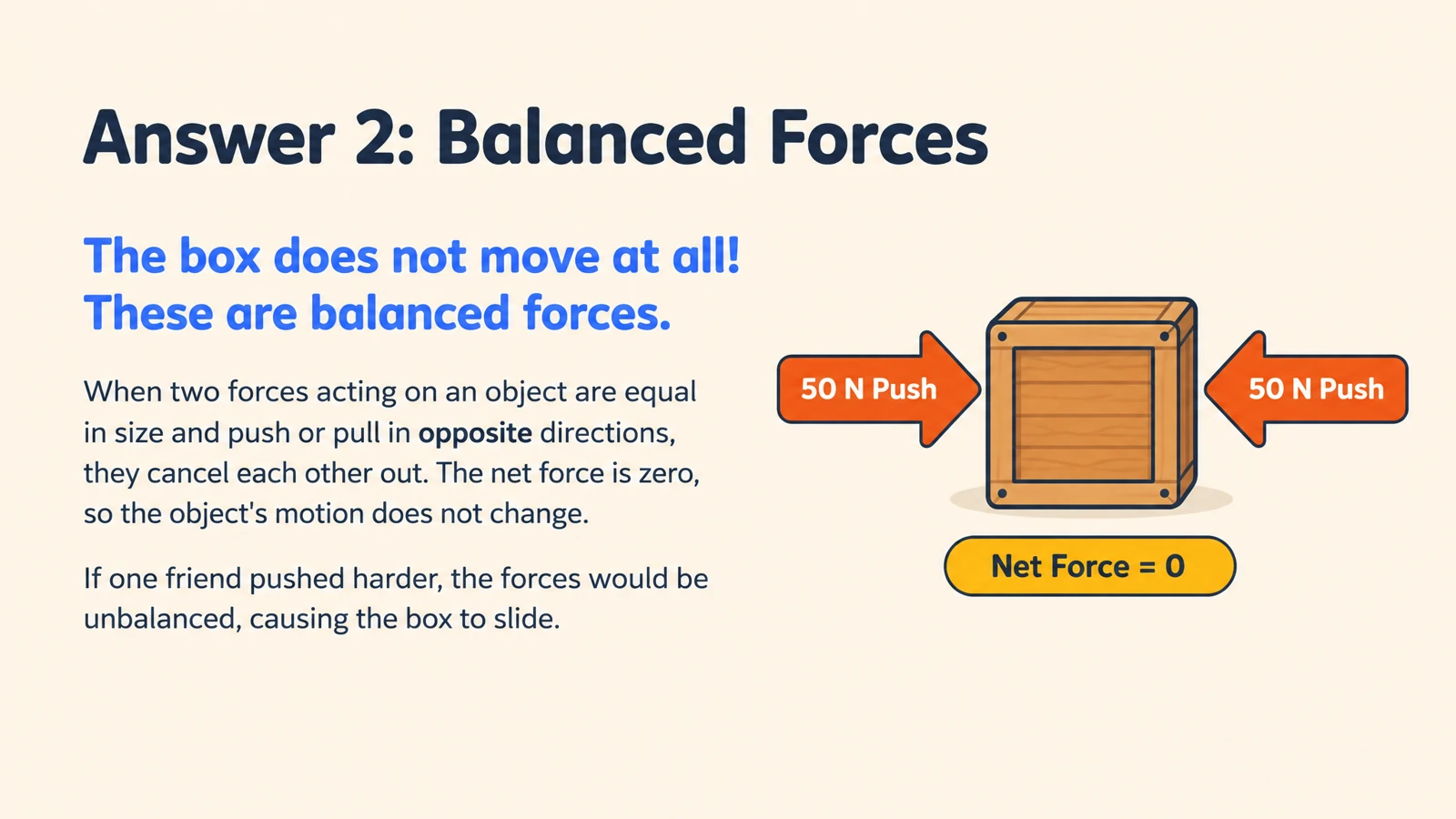
The net force is zero, so the object has no acceleration. It can remain at rest or continue moving with constant velocity.
Inertia is the resistance to a change in motion. Newton’s first law connects this idea to the behavior of an object when the net force is zero.
For a given mass, a greater net force produces greater acceleration. For the same net force, a greater mass produces less acceleration, expressed by F = ma.
Interaction forces come in equal-and-opposite pairs acting on different objects. Identify both objects when explaining Newton’s third law.
Describe pushing a cart, stopping a ball, or stepping off a boat. Name the objects and forces so the law connects to something you can picture.
Use a short, focused practice session to connect the answers to what you are learning.
Begin with what happens to the motion. Then explain how the forces relate to that change.
For a third-law example, name both objects and the force each exerts on the other. This keeps the pair distinct from balanced forces on one object.
Ask for energy, circuits, waves, or another unit. Include the learner level and whether you want conceptual prompts or worked examples.
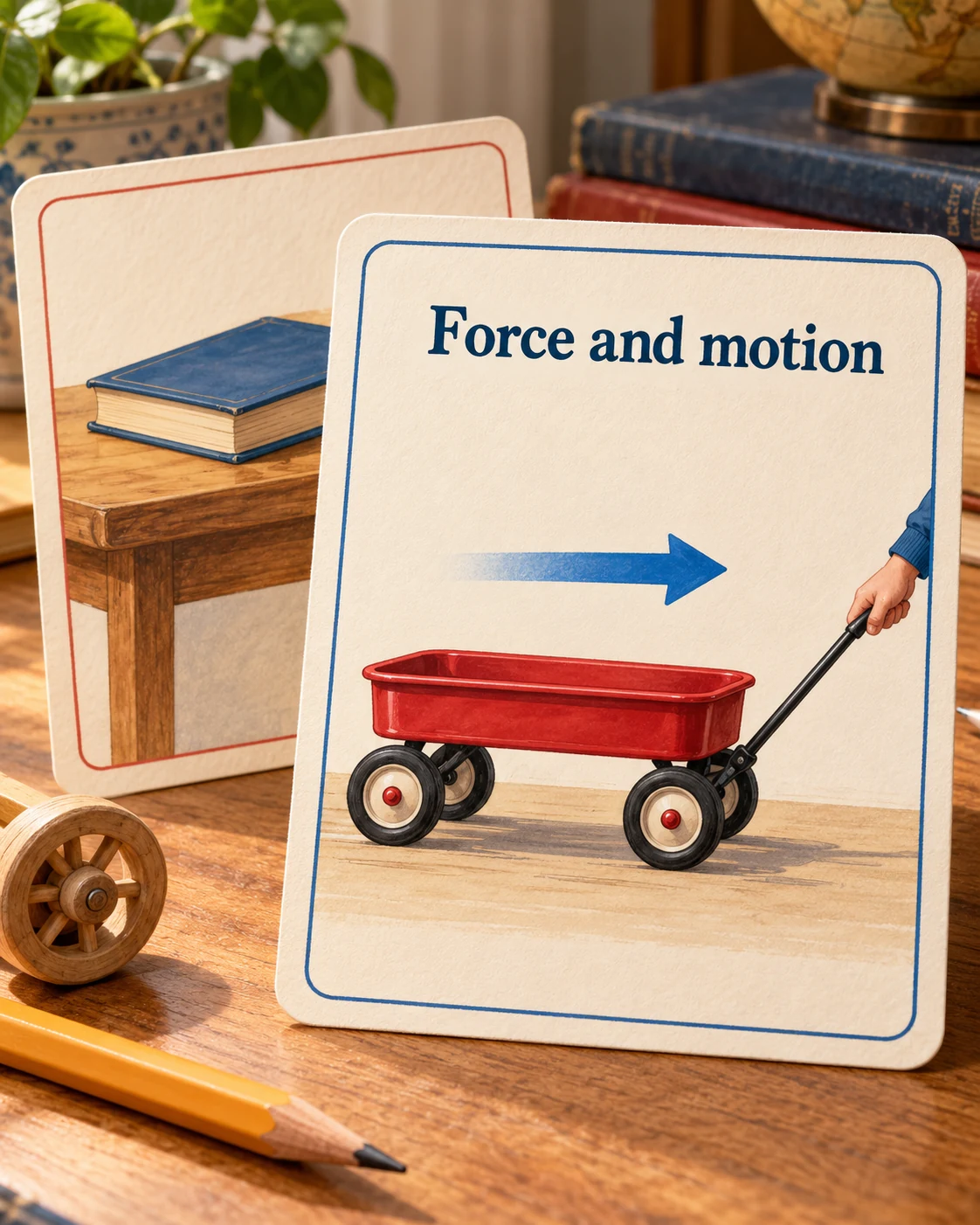
Five illustrated pairs fill the ten-page sample PDF. Use question pages for recall and keep answer pages for the discussion afterward.
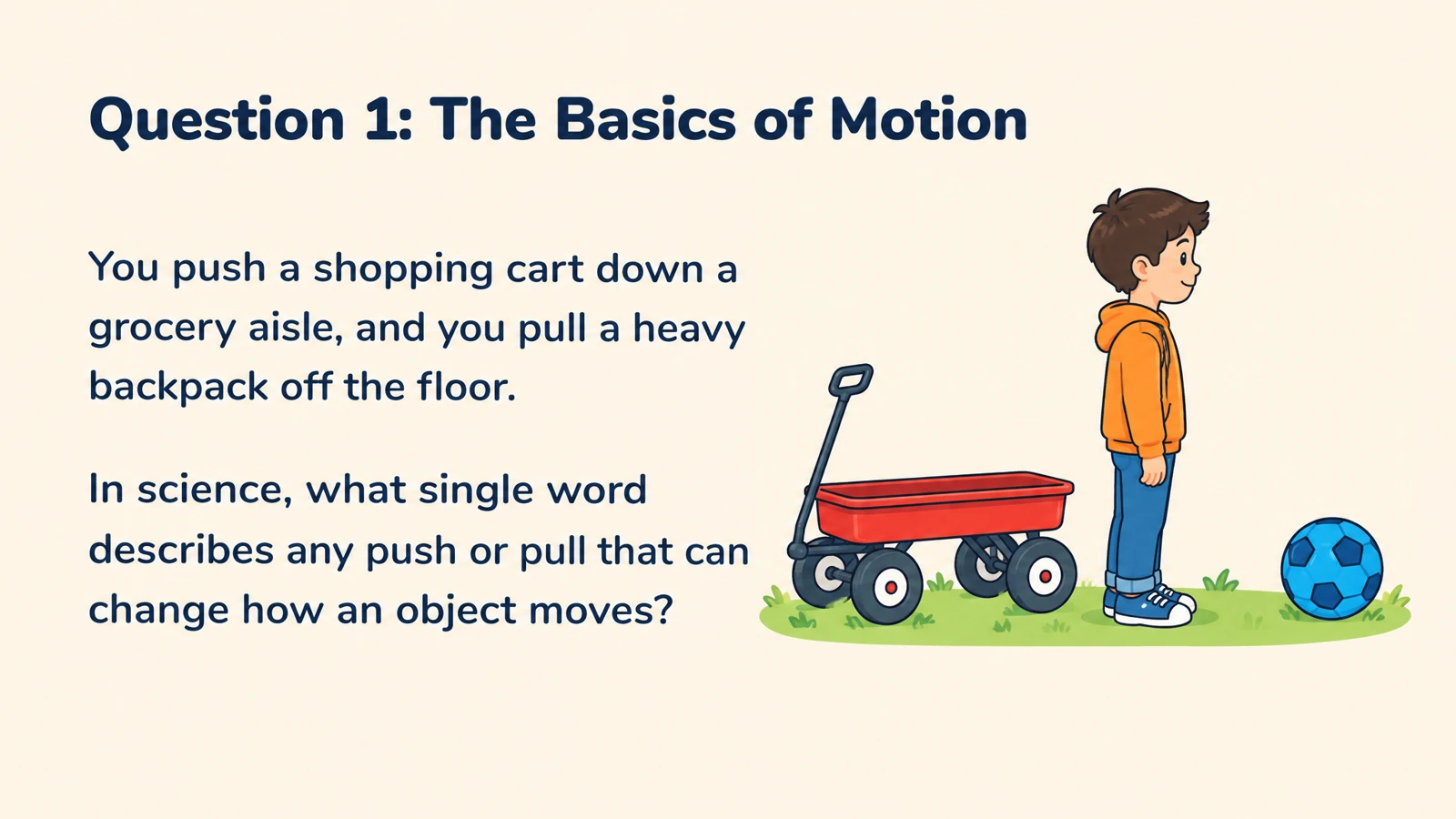
Describe the situation before naming the force. The download contains all five questions and their illustrated explanations.
Download the Forces and Motion PDF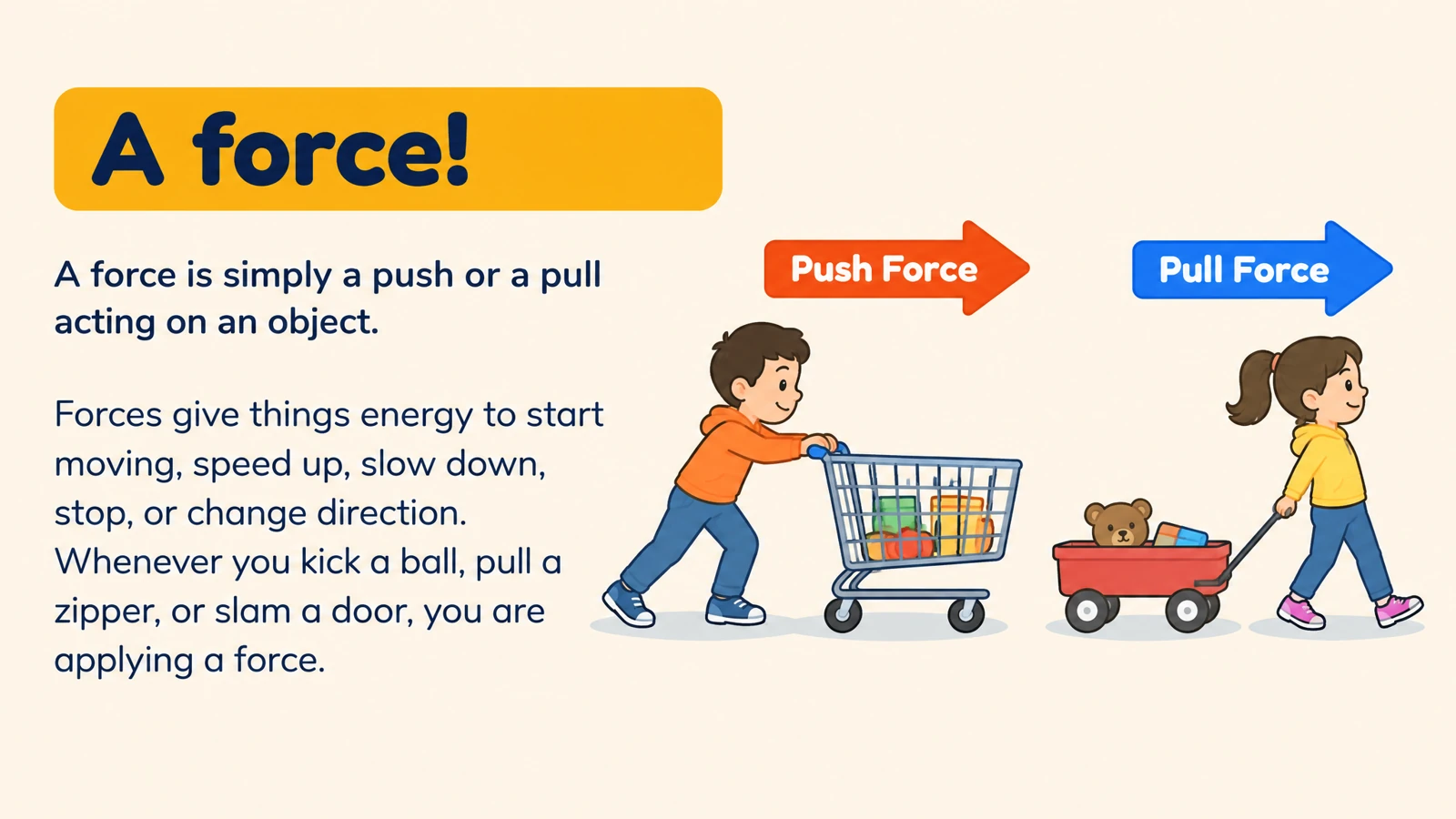
Use the answer image to connect the physical idea with the objects involved. Ask how the explanation applies to another everyday situation.
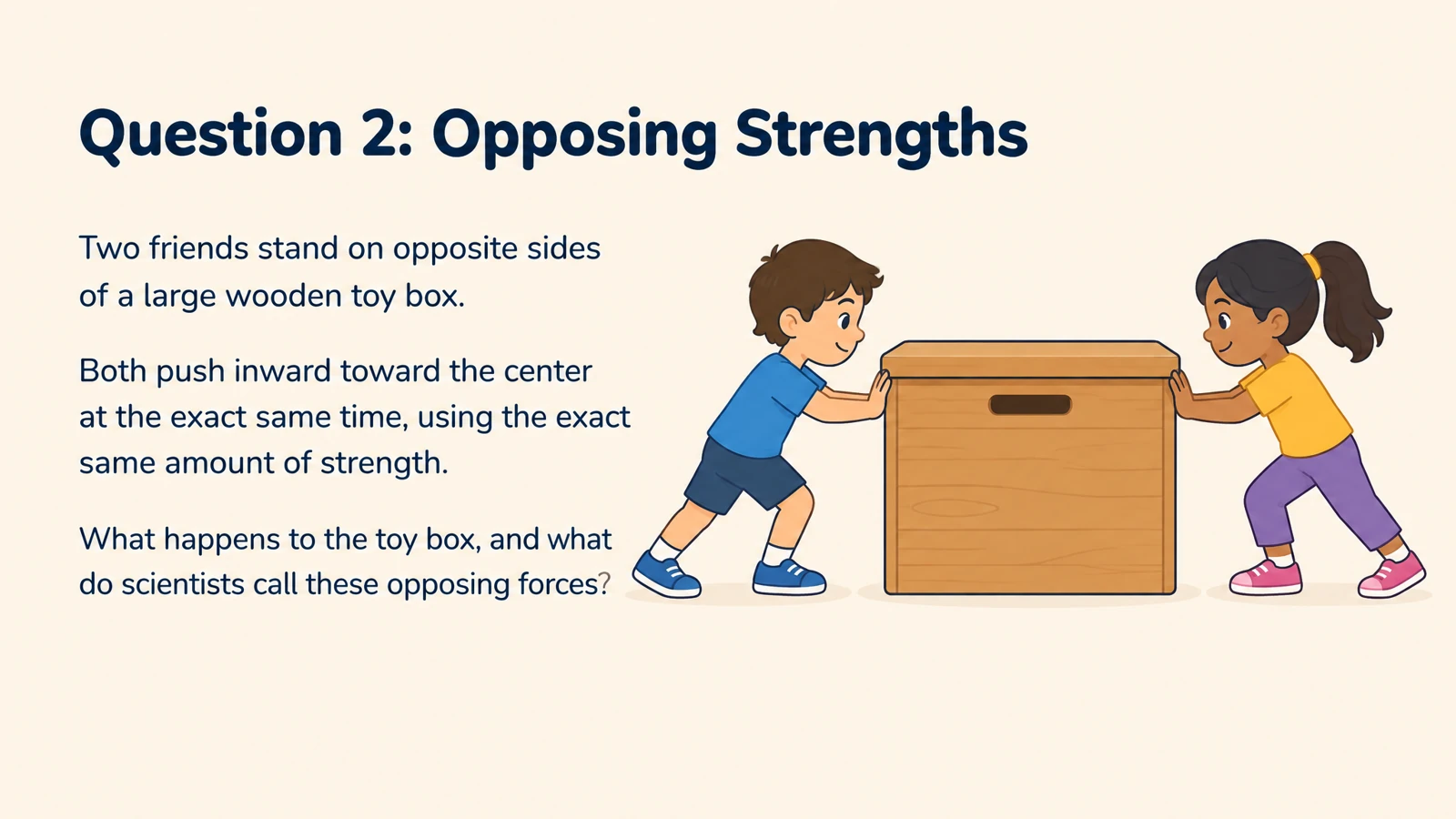
Continue through the set to distinguish forces, inertia, and interactions. Choose the pages that fit the part of the topic you are revising.
The five pairs cover force, balanced forces, inertia, the relationship between mass and acceleration, and action-reaction pairs.
This example emphasizes conceptual explanations of everyday motion. You can create a new set focused on formulas, quantities, or worked examples by describing that goal.
Explain the pictured situation before revealing the answer. Identify the forces or interacting objects and connect them to the relevant law.
Yes. Paste notes or upload your material. Specify the unit, level, and concepts you want the set to cover.
Yes. Describe the topic and the explanations you need. Ask for comparisons, processes, or examples suited to your course.
Yes. The PDF contains the five question-and-answer pairs. Choose the pages you want to print for a review or partner activity.
Yes. Export editable PPTX to adapt the text and visual elements in PowerPoint, then print or present the result.
Explore fraction models, comparisons, and printable math practice.
Revisit atoms, ions, and bonding through visual explanations.
Connect questions, variables, fair tests, and evidence.
Break a chapter into concepts, processes, and examples to recall.
Carry the ideas from a YouTube lesson into a visual recall set.
Explore eleven complete illustrated sets and download their PDFs.
Make illustrated cards you can take to the study table or classroom.
Organize a practice set around your revision topics and goals.
Create cards around the ideas you want to explain with confidence.