
How to Make a Case Study Presentation That Tells a Clear Story
A practical guide to building an evidence-led case study presentation with a clear problem, decision, approach, measurable result, and transferable lesson.

A practical guide to building an evidence-led case study presentation with a clear problem, decision, approach, measurable result, and transferable lesson.

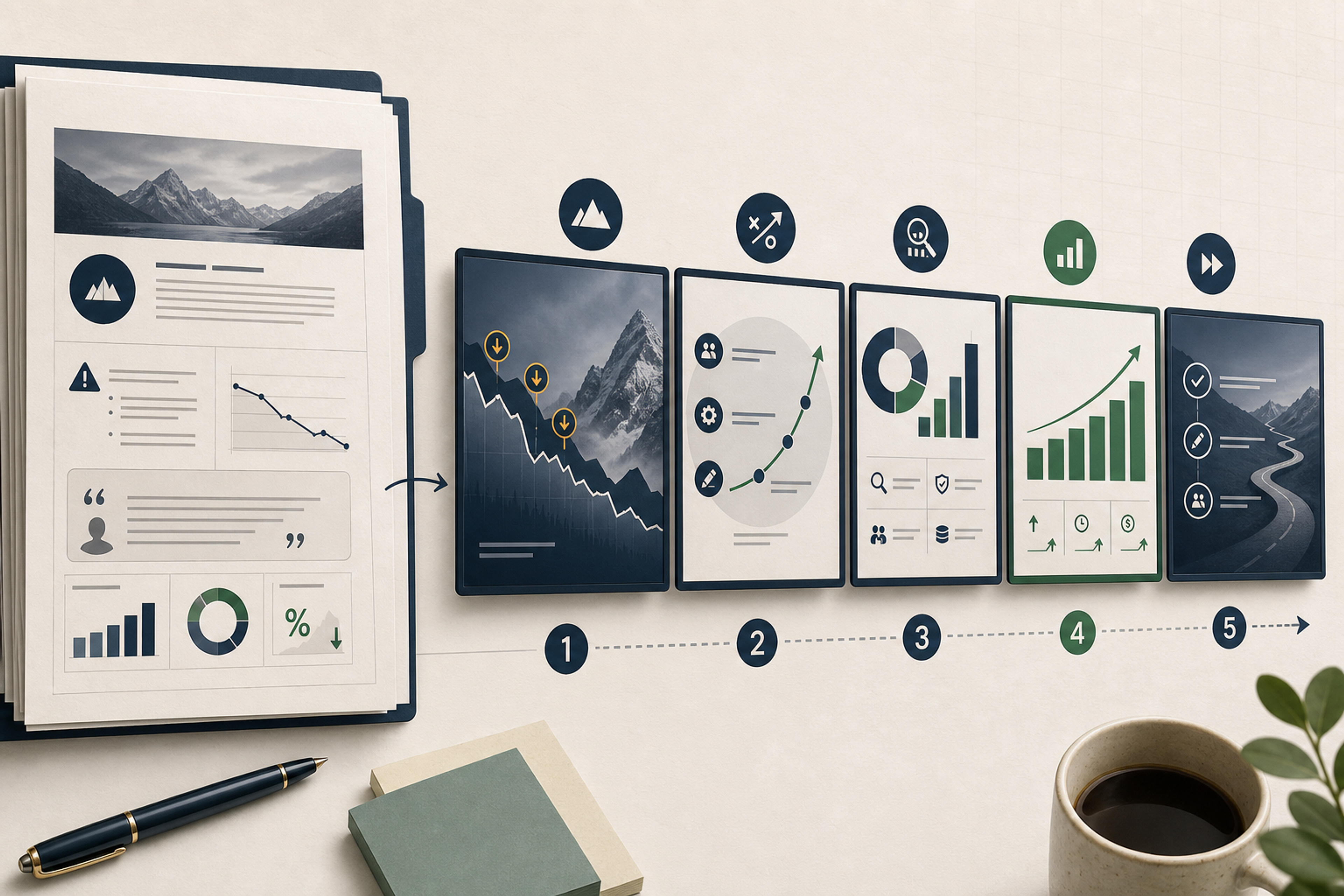
A case study presentation is persuasive when the audience can see what changed, why it changed, and what proves the change. The strongest decks do not simply summarize a project in chronological order. They turn the case into an evidence-led story: a meaningful situation, a costly problem, a consequential decision, a credible approach, a measurable result, and a lesson the audience can use.
This structure works for customer success stories, consulting engagements, marketing campaigns, product projects, academic cases, operational improvements, and portfolio presentations. The details vary, but the standard of proof does not: the result must be connected to the intervention rather than placed beside it as an unsupported claim.
A written case study can preserve background, quotations, implementation detail, and methodological context. A presentation has to create understanding in real time.
That means the deck must make five decisions on the reader's behalf:
The CDC's case-study guidance recommends defining the audience and learning goals before writing, then covering context, the problem, the response, challenges, outcomes, and lessons. OpenStax similarly describes case studies through background, methods, findings, and analysis. For a presentation, these ingredients become more effective when organized around a visible change rather than presented as a report outline.
Before designing slides, write the case in one sentence:
[Who] faced [specific high-stakes problem]; after [decisive intervention], [credible evidence of change] showed [meaningful outcome], revealing [transferable lesson].
For example:
A regional support team faced rising wait times after rapid customer growth; after separating simple requests from specialist cases and redesigning routing rules, median response time fell while satisfaction improved, showing that demand segmentation—not additional headcount—was the primary capacity lever.
Notice what this sentence does not include: every workshop, stakeholder, tool, or task completed during the project. Those details matter only when they explain why the intervention worked or help another audience apply the lesson.
If the sentence contains three different problems, four interventions, and five unrelated outcomes, the case is not yet focused enough for a presentation.
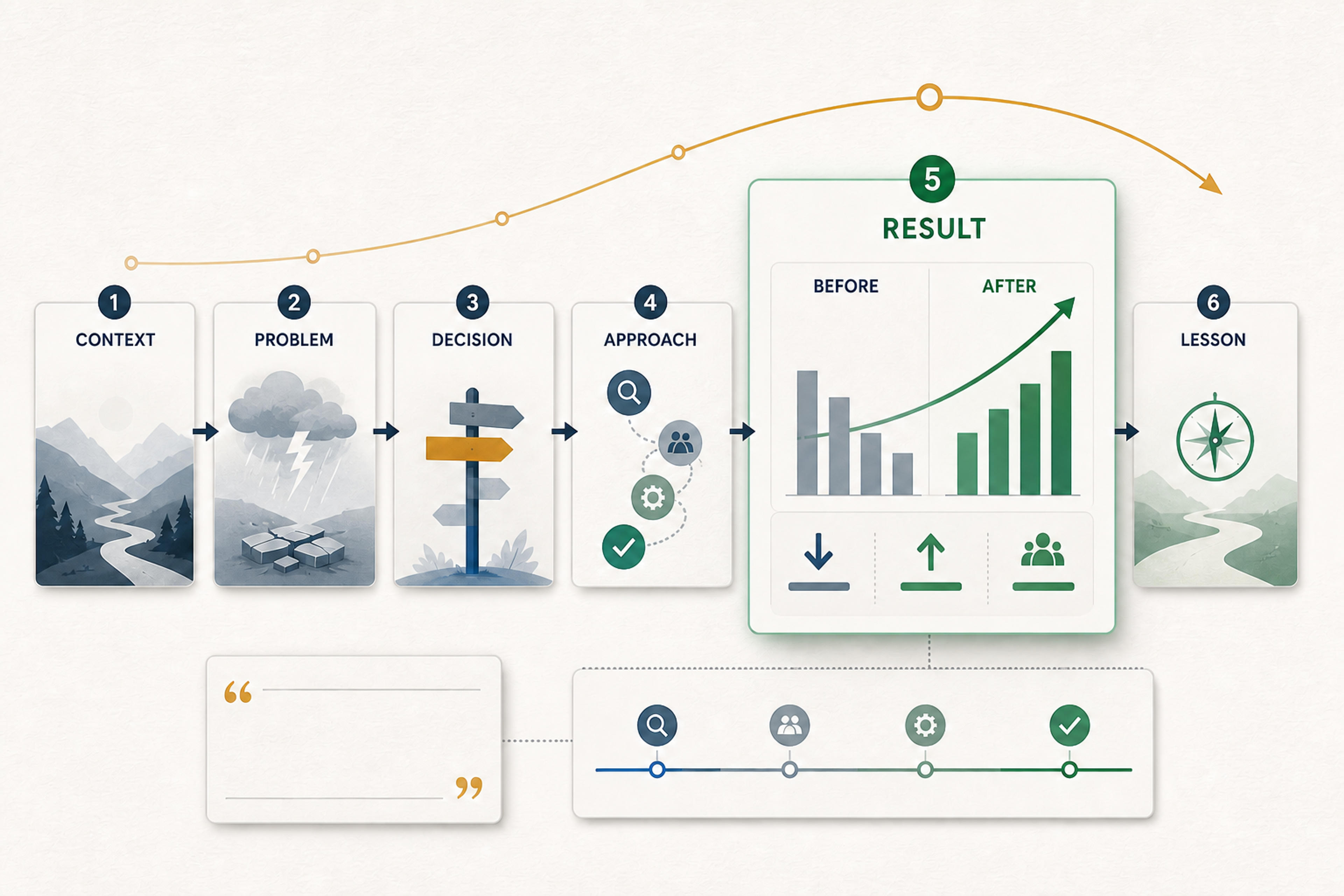
The following sequence creates tension, explanation, proof, and transfer:

The decision stage is frequently missing from weak case studies. Without it, the team appears to move automatically from problem to activity. Showing the decision makes the actors visible, clarifies the trade-off, and gives the audience a reason to care about the approach.
A concise client or customer case can work in 7–10 slides. A consulting readout or academic case may need additional analysis and appendix material.
| Slide | Question it answers | Recommended content |
|---|---|---|
| 1. Outcome-led title | Why should I pay attention? | The result or transformation, not “Case Study” |
| 2. Situation snapshot | Who was involved and what mattered? | Relevant organization, user, market, or operating context |
| 3. The problem in evidence | What was going wrong? | Baseline metric, observed behavior, process failure, or customer pain |
| 4. The decision | What choice changed the path? | Options, constraints, trade-offs, and chosen direction |
| 5. The approach | What was actually done? | Three to five linked actions, not a list of every task |
| 6. Implementation | How did the change happen? | Timeline, roles, rollout, experiment, or operating model |
| 7. Results | What changed? | Before-and-after comparison with timeframe and definition |
| 8. Why it worked | What connects the action to the result? | Mechanism, adoption behavior, process change, or qualitative evidence |
| 9. Lesson and next step | What should the audience take away? | Transferable principle, recommendation, and CTA |
Use an appendix for detailed methodology, secondary metrics, interview excerpts, implementation screenshots, and alternative analyses. The main deck should remain narratively complete without them.
Upload it to SlidesPilot and turn the context, challenge, approach, evidence, and results into a structured, editable PowerPoint.
Turn My Case Study into SlidesSales, executive, and portfolio audiences often benefit from an outcome-led opening:
This is more useful than “Customer Success Case Study” because it tells the audience what the case proves.
For teaching or academic discussion, you may intentionally withhold the result and present a decision-forcing case. In that format, give the audience the context, evidence, and alternatives available at the time, ask them to make the decision, and reveal the outcome later. The correct opening therefore depends on the job the case must do.
A case has no tension if the problem is described only with adjectives: inefficient, fragmented, difficult, outdated, or low-performing.
Replace labels with observable consequences:
A strong problem slide usually pairs one baseline signal with one human or operational consequence. For example, a chart of rising resolution time can be paired with a simplified process showing where cases stalled. That combination makes both scale and mechanism visible.
Avoid inflating the stakes. A credible case is more persuasive than a dramatic one. State the real boundary: which team, time period, market, customer segment, or process the problem affected.
Most projects contain a moment when the team chose among competing paths. That moment is the intellectual center of the case.
Use a decision slide to show:
This can be a simple comparison table, decision tree, 2×2, or set of alternative principles. Do not manufacture options after the fact to make the chosen path look inevitable. The value comes from showing the genuine reasoning.
Project teams often overfill the approach section because they remember the work in tasks: discovery, workshops, interviews, design, implementation, launch, training, and reporting.
The audience needs a smaller number of actions linked to the result. Ask of every activity: What changed because of this work?
Instead of:
write:
Now the audience can see how the actions form a mechanism rather than a calendar.
Not every metric is equally persuasive. Start with the outcome claim, then identify the evidence required to support it.

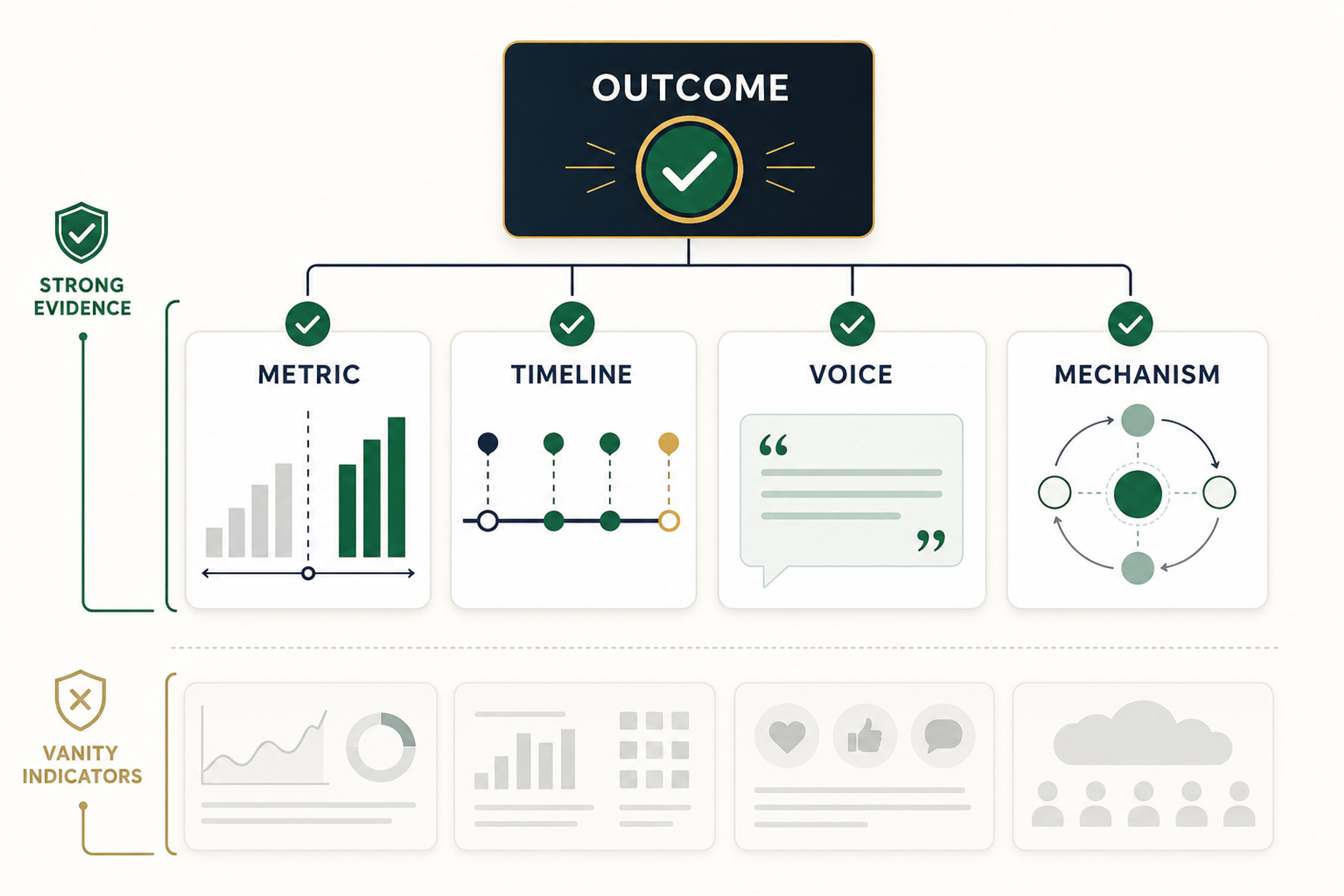
Four types of evidence work especially well together:
Show the measure closest to the promised result: conversion, completion time, defect rate, retention, learning outcome, cost, adoption, revenue, or another defined result. Include the baseline, comparison period, unit, population, and timeframe.
Show when interventions occurred and whether the pattern changed afterward. A timeline cannot prove causality by itself, but it helps the audience understand sequence and rule out vague storytelling.
A quotation can explain experience, friction, or perceived value that a metric does not capture. Use a real, approved quotation with meaningful context. Do not let a positive quote substitute for outcome evidence.
Explain why the approach should have produced the observed result. This might be a shorter process, a new behavior, improved matching, reduced variation, a clearer incentive, or better information at a decision point.
Avoid building the case around vanity indicators that are distant from the outcome. Impressions, attendance, page views, files created, or workshops completed may describe activity, but they do not automatically prove business or user impact.
The result slide should answer four questions:
Use language that matches the design. A randomized experiment may support a causal claim. A before-and-after operational case usually supports a more bounded statement: the result followed the intervention and is consistent with the proposed mechanism. The deck can be commercially confident without pretending the evidence is stronger than it is.
When several outcomes matter, choose one headline result and show secondary benefits beneath it. If every metric receives equal visual weight, the audience cannot tell what success means.
A quotation earns a slide when it does one of three jobs:
Keep enough context to interpret the quote: role, relationship to the case, and when it was collected. Obtain approval for customer-facing use. If attribution must be anonymous, describe the role honestly rather than inventing a name or portrait.
Generic praise—“The team was great to work with”—rarely advances the case. A useful quote contains information: what became easier, which objection was resolved, or what people can now do that they could not do before.
The source case can support several decks, but each one should make a different selection.
Lead with the customer problem, the result, speed to value, and evidence that the outcome is relevant to a similar buyer. End with a clear next step.
Lead with strategic relevance, decision, return, risk, and repeatability. Keep implementation detail at the level required to approve scale or investment.
Show the diagnostic logic, alternatives, recommendation, evidence, and implications. Make clear which findings come from analysis and which are management choices.
Make your own role explicit. Separate team activity from your decisions, artifacts, and contribution. Discuss constraints and what you would change.
Frame the decision, provide evidence in stages, and make room for competing interpretations. The learning objective matters more than promoting the final solution.
If the case already exists as a document, report, or customer story, SlidesPilot's case study to PPT workflow can turn it into an editable presentation draft.
Use this process:
A focused prompt could read:
Turn this case study into a nine-slide presentation for prospective customers in the same industry. Lead with the measurable outcome, explain the original operating problem, show the decision and three-part intervention, and support the result with the approved baseline, timeframe, and customer quotation. End with the lesson a similar organization can apply. Do not invent metrics, quotations, dates, or client details.
The important instruction is not “make this look professional.” It is the narrative and evidence brief. Visual polish cannot rescue an unclear claim.
Microsoft's presentation guidance recommends simple text, readable type, high contrast, and visuals that convey the message without overwhelming the audience. For a case study, translate that into several practical rules:
Photography can establish context, but it should not displace evidence. Generic office photos and handshakes make a case look less specific. Prefer real product, process, customer, environment, or outcome visuals when permission is available.
A long company introduction delays the problem. Give only the context needed to understand the stakes.
Workshops and deliverables are inputs. Show what they changed in the process, decision, product, or behavior.
“Improved engagement” is not evidence. Define the measure, comparison, audience, and period.
Explain what the design supports. Strong commercial storytelling and careful reasoning can coexist.
Select a quotation that explains the problem, mechanism, or value—not just approval.
The audience should know what this case means for them. State the principle, recommendation, or next step.
Before the deck is ready, confirm that:
A focused customer or sales case often works in 7–10 slides. A consulting, academic, or portfolio case may require more analysis and an appendix. Use only enough slides to establish context, decision, approach, evidence, result, and lesson.
When the result is known and relevant, use an outcome-led title. For a classroom decision case, frame the situation and decision without revealing the outcome too early.
Choose the measure closest to the promised outcome. Add supporting process, adoption, quality, or experience evidence only when it helps explain the result.
Yes, especially for exploratory, design, organizational, or qualitative work. Use credible observations, participant evidence, artifacts, process change, and clear analytical reasoning. Be precise about what the evidence demonstrates.
Yes. AI can extract the narrative and build an editable first draft from a written case. Give it the audience, transformation, approved evidence, and required boundaries, then verify every factual claim against the source.
A memorable case presentation is not memorable because it is dramatic. It is memorable because the audience can follow the chain from problem to decision, from decision to action, and from action to evidence. When that chain is clear, the case becomes more than a success story: it becomes a useful model for the next decision.
Transform detailed case studies into professional PowerPoint presentations
Turn Word documents into clear, structured, editable PowerPoint presentations with AI.
Turn an idea into a complete, structured presentation. Define the audience and goal, guide the tone and length, and let SlidesPilot build the storyline, slide plan, content, and visual direction.
Practical guides for turning documents, ideas, research, and web content into better presentations with AI.
Upload the source, choose the audience, and let SlidesPilot build an editable case study deck with a clear problem-to-result story.