

Business Plan Presentation Structure: A 12-Slide Investor-Ready Outline
A practical 12-slide structure for turning a written business plan into an investor-ready presentation.
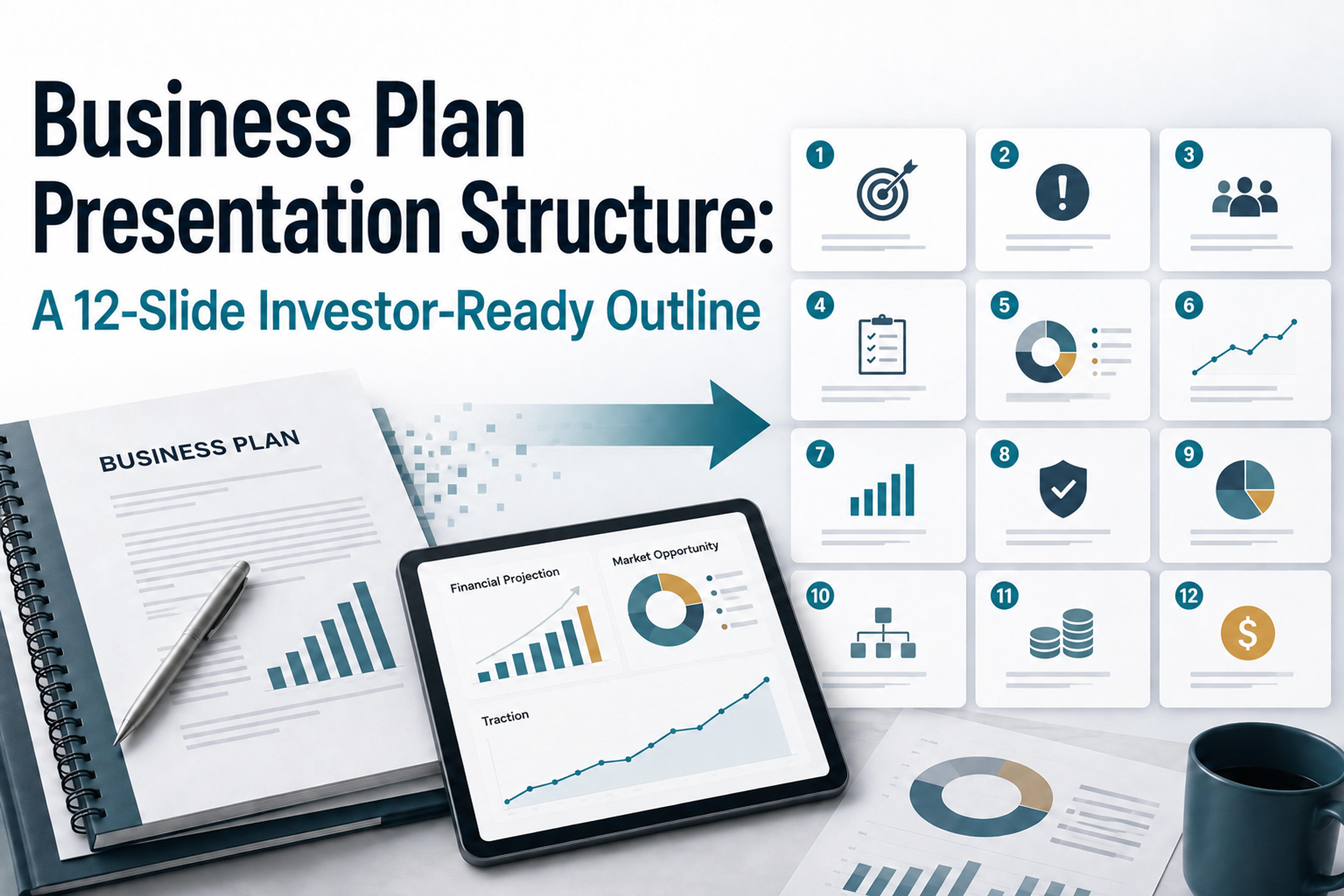
A practical 12-slide structure for turning a written business plan into an investor-ready presentation.
A strong business plan presentation structure does not read your plan aloud. It turns the written plan into an investor-ready story: what problem you solve, why now, who buys, how the business makes money, how you will grow, and what support you are asking for.
Investors expect enough detail to judge the opportunity, but they also need a clear sequence. The goal is not to squeeze every section of a business plan into slides. The goal is to make the business easy to understand, compare, question, and remember.
Use the 12-slide structure below as a practical outline for a pitch meeting, accelerator demo, internal funding discussion, or early-stage investor deck.
Before opening a slide tool, define the presentation outcome.
Ask yourself:
CO- by U.S. Chamber of Commerce suggests tailoring the business plan to the audience evaluating it, because lenders, investors, landlords, and internal stakeholders look for different proof. In presentation terms, that means choosing evidence based on the decision-maker: repayment logic and cash flow for lenders, return potential and team credibility for investors, lease-fit details for landlords, and execution tradeoffs for internal leaders.
An investor presentation needs the size of the opportunity, growth story, defensible model, traction, financial logic, and funding ask. An internal business presentation may need strategic fit, resource requirements, risks, timeline, and operating milestones. A lender presentation may need repayment logic, cash flow assumptions, and business stability.
Research the audience before you pitch, including the industries, requirements, and investment preferences that shape whether they will care. Do that before outlining the deck so the first five minutes answer the concerns already in the room.
Write one sentence before outlining the deck:
We are asking ___ to support ___ because ___ will create ___.
That sentence becomes the presentation's center.
Use the written plan as source material, then translate each section into a slide job. This keeps the presentation from becoming a document summary.
| Business plan section | Investor question | Slide message | Evidence to keep | Best slide form |
|---|---|---|---|---|
| Executive summary | What is the opportunity? | The business solves a valuable problem for a clear market. | One-line concept, customer, outcome | Opening promise slide |
| Problem | Why does this matter? | Customers have a costly or urgent pain. | Pain points, current workaround, stakes | Problem story or customer quote layout |
| Solution | Why is this better? | The product gives customers a clearer path to the outcome. | Core workflow, product proof, benefits | Product flow or before-after |
| Market | How big can this become? | The target market is specific and reachable. | Segment, buyer, market logic | Market wedge diagram |
| Business model | How does it make money? | Revenue grows through a simple, understandable model. | Pricing logic, unit economics, margin drivers | Revenue model table |
| Go-to-market | How will you acquire customers? | Growth starts with focused channels and repeatable motion. | Channels, sales cycle, partnerships, milestones | Channel roadmap |
| Competition | Why can you win? | The company has a defensible position. | Alternatives, differentiation, moat | Positioning matrix |
| Financial plan | What does growth look like? | The plan connects assumptions to milestones. | Revenue, costs, cash needs, key assumptions | Financial snapshot |
| Funding ask | What do you need? | The ask funds the next measurable stage. | Amount, use of funds, milestones | Ask-and-use slide |
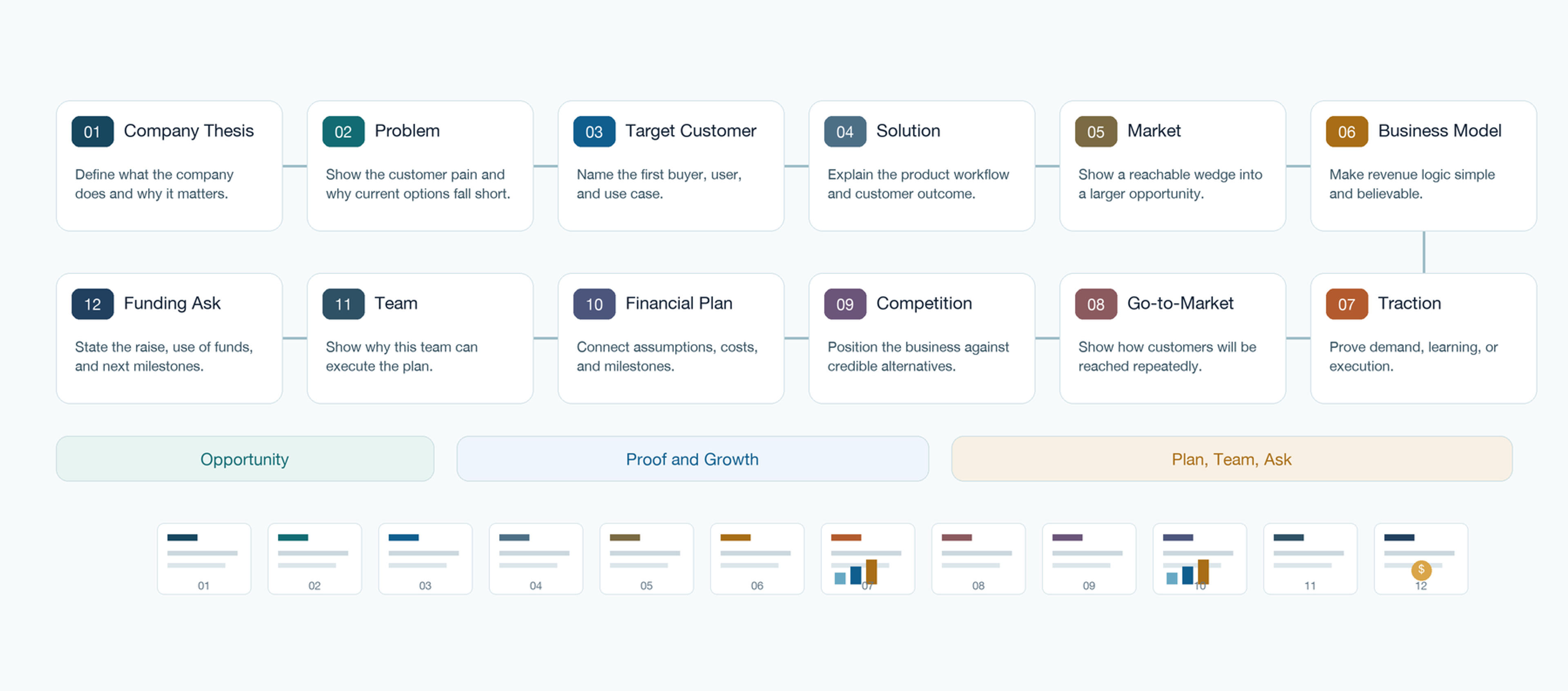
The 12-slide sequence below works because it follows how investors evaluate a company: first the opportunity, then the proof, then the plan, then the ask.
Open with the company name, category, target customer, and one sentence that explains the opportunity. This slide should let an investor repeat what you do after 30 seconds.
Do not start with a long mission statement. A mission can be inspiring, but the opening slide needs business clarity.
Example message: "We help independent clinics reduce missed appointments with automated patient follow-up."
Show the pain your customer already feels. The best version is concrete: who has the problem, when it appears, what it costs, and why existing behavior is not good enough.
Avoid generic statements like "the industry is inefficient." Investors hear that constantly. Name the actual friction.
Example message: "Small clinics lose revenue and staff time when patients miss appointments without early follow-up."
Define the first customer segment. A broad market can be exciting, but the first wedge needs to feel reachable.
Include buyer role, user role, setting, urgency, and the moment they would choose your product. If your business plan includes several audiences, choose the segment that best supports your initial growth story.
Example message: "The first buyer is a clinic operations manager responsible for appointment utilization and patient communication."
Upload the written plan to SlidesPilot and create a structured, editable investor presentation you can refine.
Turn My Business Plan Into SlidesShow how the product solves the problem. Keep the explanation focused on the customer outcome, not every feature.
A strong solution slide usually includes three parts: the trigger, the workflow, and the result. If you have product screenshots, use only the screens that make the customer journey obvious.
Example message: "The platform detects at-risk appointments, sends automated follow-ups, and helps staff fill gaps earlier."
Explain why this business can become large enough to matter. This slide should connect the target segment to a larger opportunity without making the story too abstract.
Use a market wedge: start with the beachhead customer, then show logical expansion. If you include market sizing, make the assumptions visible enough that the audience can follow the logic.
Example message: "Starting with independent clinics creates a focused wedge into broader outpatient scheduling workflows."
Show how the company makes money. Investors should understand who pays, what they pay for, and what drives revenue growth.
Good business model slides include pricing logic, revenue streams, contract type, gross margin drivers, or unit economics when relevant. Keep the slide simple enough to explain in one minute.
Example message: "Revenue grows through monthly clinic subscriptions tied to location count and patient communication volume."
This is the slide where the presentation moves from idea to evidence. Use traction that proves demand, learning, or execution.
Depending on stage, traction can include pilots, revenue, active users, signed letters of intent, retention, waitlist quality, partner interest, product usage, or operational milestones. Do not bury the strongest proof in a paragraph.
Example message: "Pilot clinics are using automated follow-up to recover appointment slots that would otherwise stay empty."
Show how you will reach customers repeatedly. A good go-to-market slide is more specific than "sales and marketing." It names the channels, motion, customer journey, and near-term milestones.
Investors want to know whether your customer acquisition plan matches the buyer. A self-serve product, enterprise sale, channel partnership, and services-led motion need different proof.
Example message: "The first growth motion combines clinic software partnerships, direct outreach to operations managers, and referral loops from pilot customers."
Place your company among alternatives. The competition is not only direct competitors; it also includes spreadsheets, manual work, agencies, legacy software, and doing nothing.
Use this slide to show why customers would choose you and why that advantage can last. Avoid a matrix where your company magically checks every box. A credible competitive slide shows tradeoffs.
Example message: "Unlike generic reminder tools, the product focuses on appointment recovery workflows for clinics with limited staff capacity."
Summarize the financial plan in a way that supports the investment story. Investors do not need every spreadsheet tab on the slide. They need the assumptions, growth logic, cost drivers, and milestone connection.
Show the next stage of the business: what changes after the raise, what you will measure, and what milestones prove progress.
Example message: "The plan funds product completion, pilot expansion, and the first repeatable sales motion."
Show why this team is suited to the market and plan. Focus on relevant experience, domain knowledge, technical ability, sales access, operating history, or advisory support.
This slide should answer: "Why this team, for this problem, now?"
Example message: "The team combines clinic operations experience, healthcare software engineering, and early customer relationships."
End with the ask. Include what you are raising, how funds will be used, and which milestones the funding unlocks.
Do not make the final slide a vague thank-you. Investors should leave knowing exactly what conversation should happen next.
Example message: "The raise supports product launch, pilot conversion, and the first sales hires needed to reach the next financing milestone."
A business plan presentation should preserve the logic of the plan while changing the level of detail. Keep the material that helps investors evaluate the opportunity quickly:
The key is to turn written sections into slide messages. A paragraph that explains your marketing strategy may become one slide headline, three channel cards, and a milestone timeline.
Investors expect substance, but the main deck should not carry every operational detail. Compress anything that slows the story without changing the decision.
Move these details to appendix slides:
Appendix slides are useful because they let you answer questions without overloading the main flow. Build them after the core story is clear.
Here is a typical written business plan paragraph:
Our initial go-to-market strategy will focus on independent outpatient clinics that have appointment scheduling challenges and limited administrative staff. We will begin with direct outreach to clinic managers, build relationships with regional clinic networks, and explore partnerships with practice management software vendors. The goal is to validate repeatable customer acquisition before expanding to larger healthcare groups.
A weak slide would paste that paragraph under the title "Marketing Strategy."
A stronger slide turns it into a structured investor message:
| Slide element | Better version |
|---|---|
| Slide headline | Growth starts with a focused clinic operations wedge |
| Channel 1 | Direct outreach to clinic operations managers |
| Channel 2 | Regional clinic network relationships |
| Channel 3 | Practice management software partnerships |
| Milestone | Prove repeatable acquisition before larger healthcare groups |
| Visual | Three-channel roadmap with a 6- to 12-month milestone line |
The stronger version gives investors a strategy they can evaluate. It also creates a natural discussion about channel priority, sales cycle, and evidence.
Your slides should feel decisive, not decorative. Every slide needs a message title, a small amount of evidence, and a visual form that makes the decision easier.
Use these rules:
If a slide needs a long voiceover to make sense, rewrite the slide message first. Investors should understand the point before you explain the detail.
Use this checklist before you send or present the deck:
For investor conversations, 10-15 slides is usually a workable range. The 12-slide structure in this guide gives you enough room to cover the opportunity, product, market, traction, plan, team, and funding ask without turning the deck into a document.
Use the business plan as source material, then turn it into an audience-ready narrative. Keep the main deck focused and use appendix slides for detailed financials, research and backup analysis instead of including the full business plan.
The most important slide depends on the risk investors are trying to evaluate. Early in the conversation, the problem, solution, traction, and business model slides usually carry the most weight because they explain whether the opportunity is real and investable.
Show the key assumptions, revenue logic, cost drivers, and milestones. A slide should summarize the financial story, not reproduce the whole model. Use appendix slides for detailed tables.
End with a clear funding ask or next-step slide. State what support you need, how it will be used, and which milestones it unlocks. A strong ending makes the next conversation obvious.
A good business plan presentation structure gives you the investor narrative. The next step is turning the written plan into a deck that is clear enough to present and flexible enough to refine.
SlidesPilot helps turn Word documents, outlines, notes, and pasted text into structured, editable presentations. Start with the business plan, then shape the generated deck around the investor question, slide sequence, and evidence that matter most.
Turn Word documents into clear, structured, editable PowerPoint presentations with AI.
Turn an idea into a complete, structured presentation. Define the audience and goal, guide the tone and length, and let SlidesPilot build the storyline, slide plan, content, and visual direction.
Turn notes, paragraphs, and ideas into a clear, editable PowerPoint presentation.
Transform detailed reports into professional PowerPoint presentations
Use SlidesPilot to turn your written business plan into a structured, editable deck with a clear investor story.

