

Active Recall: How to Study with Examples That Stick
Turn a short section of notes into focused questions, practice answering from memory, and use a reusable worksheet to plan your next review.
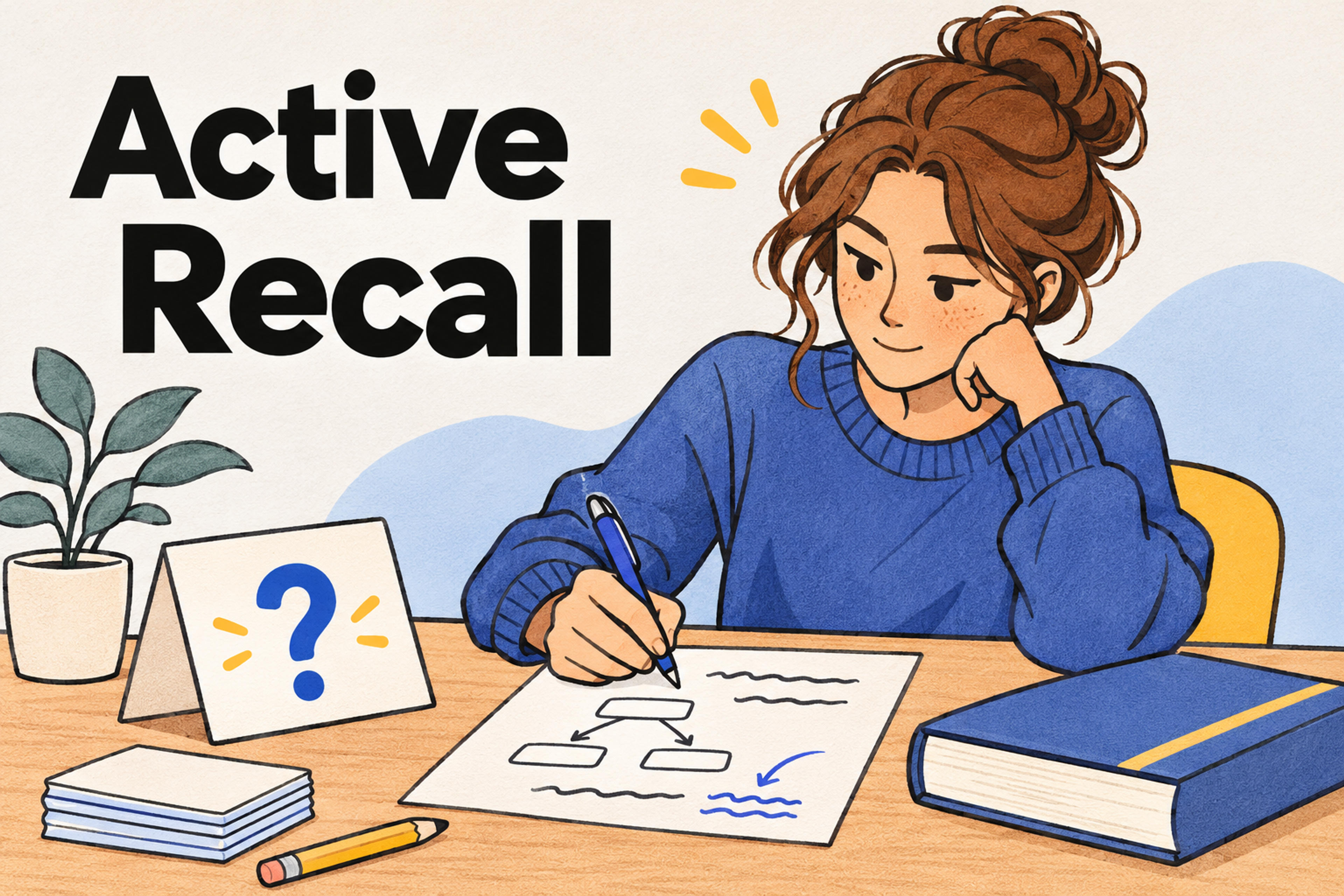
Turn a short section of notes into focused questions, practice answering from memory, and use a reusable worksheet to plan your next review.
Active recall is a study method where you retrieve information from memory before checking the answer. You close your notes, respond to a question, then use the source to correct what you missed.
You can use it with flashcards, a blank sheet of paper, a diagram, or a practice problem. The essential step is producing an answer while the explanation is out of sight.
If a chapter feels familiar but you struggle to explain it, start with one small section. This guide shows how to turn that section into a useful practice session, with examples, a review schedule, and a worksheet you can reuse.
Active recall means deliberately bringing something you have learned back to mind. In learning research, it is commonly discussed as retrieval practice or practice testing.
Reading a definition gives you the information. Answering “What does this term mean?” with the definition covered asks you to retrieve it. The answer you produce also reveals which details you understand and which need another look.
Try it now: look away from this page and explain active recall in one sentence. Then check whether your explanation includes both parts: attempting an answer from memory and checking it afterward.
You have just used the method. The same pattern works for a vocabulary word, the causes of a historical event, or the steps in a scientific process.
Retrieval gives you practice accessing knowledge and makes gaps visible. Research on practice testing also shows benefits that persist beyond the study session.
A 2021 systematic review of classroom research examined 50 experiments involving 5,374 learners. Of the 49 effect sizes the authors analyzed, 57% showed medium or large benefits from retrieval practice. That figure describes the research findings, rather than a percentage increase in anyone’s memory.
A separate meta-analysis of classroom quizzing combined 222 studies involving 48,478 students and found a medium average benefit for academic achievement. The reported effect size, g = 0.499, represents roughly half a standard deviation; it does not mean grades increased by 49.9%.
The timing of the test matters, too. In Roediger and Karpicke’s 2006 experiment, undergraduates who studied a passage once and completed three recall tests remembered 61% of its ideas a week later. Those given four study periods remembered 40%. Repeated study performed better on the test given just five minutes later.
That last finding helps explain why an easy review session can feel successful. For knowledge you need next week, include opportunities to retrieve it after a delay.
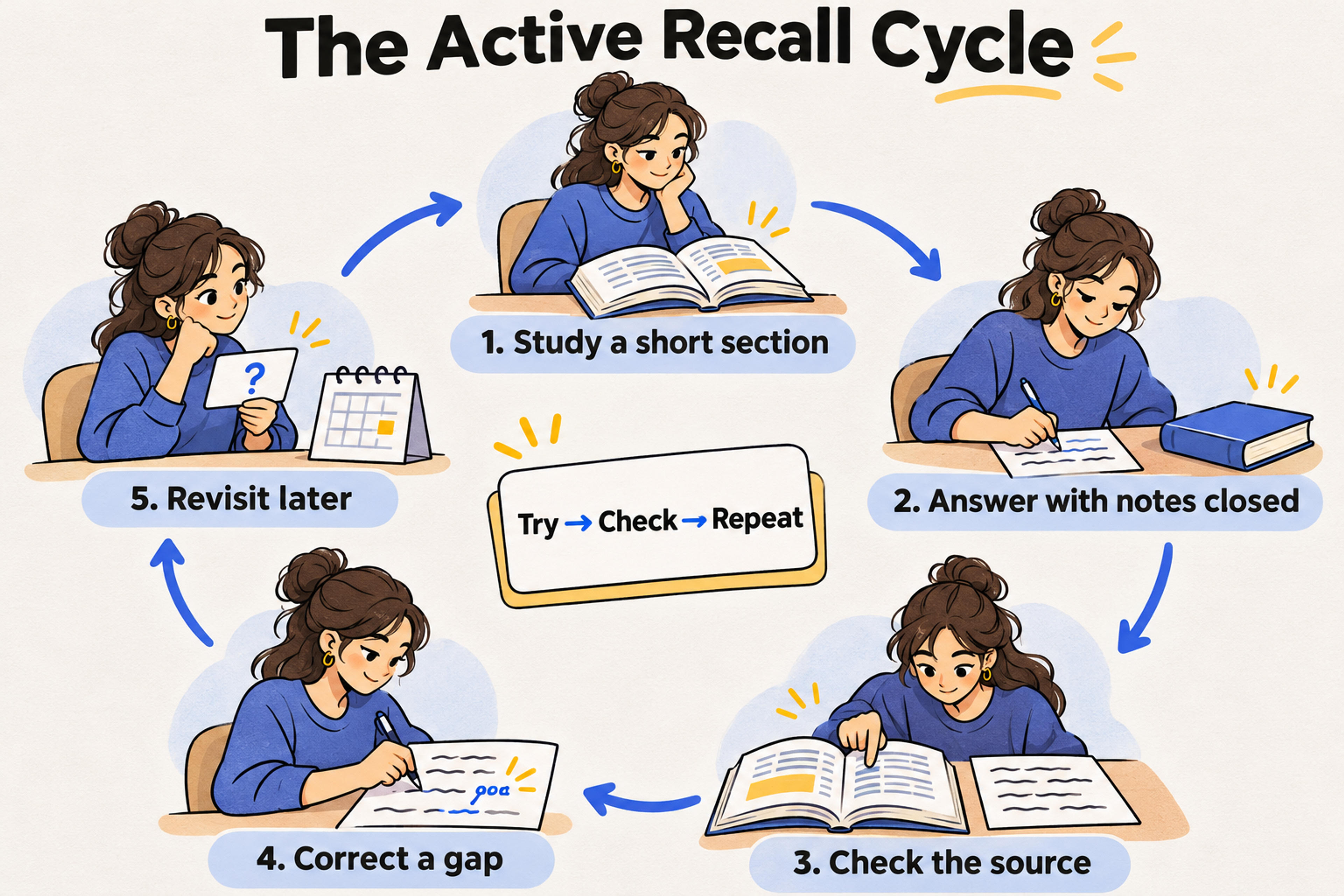
Choose a section small enough to explain in a few minutes: one process, a handful of terms, or a single argument. Keep your source nearby for checking after each attempt.
Read the section and identify its central idea. Resolve unfamiliar terms and follow any worked example before testing yourself. For a difficult topic, begin with a small part you can make sense of.
Write prompts that require a clear answer. “Explain photosynthesis” is broad; “What are the inputs and outputs of photosynthesis?” gives you a more manageable starting point.
Include different kinds of questions. Ask for a definition, a reason, a comparison, or an application. For example: “What does this term mean?”, “Why does this happen?”, and “How would the outcome change in this situation?”
Cover the answer, close the textbook, or switch away from your slides. Write, say, draw, or solve your response before looking back.
Give yourself enough time to make a real attempt. If you get stuck, record what you can remember so you have something concrete to compare with the explanation.
Reopen the source. Identify whether you missed a fact, confused two ideas, left out a step, or could not apply the concept.
Replace a vague note such as “study this again” with a specific correction: “I remembered the definition but reversed the direction of movement.” That tells you what the next attempt needs to fix.
Read the relevant explanation, cover it, and try again in your own words. If your first question was too broad, split it into smaller prompts before returning to the whole explanation.
Keep the prompt for a later session. Answer it before reviewing your notes again. A successful attempt immediately after reading the correction is a useful start; a later attempt checks whether you can still retrieve it.
Create illustrated question-and-answer flashcards from your learning material with SlidesPilot. Try each answer from memory before revealing the explanation.
Create My FlashcardsHere is a short practice passage:
Diffusion is the net movement of particles from an area of higher concentration to an area of lower concentration. Individual particles move randomly. Diffusion does not require energy supplied by the cell. At equilibrium, particles keep moving, but there is no net movement in either direction.
Read it, then cover it. Use the questions below to test yourself, keeping the answer column covered until you have made an attempt.
| Question | Answer to check after your attempt |
|---|---|
| What is diffusion, and which direction does net movement take? | Net movement from higher concentration to lower concentration. |
| Does diffusion require energy supplied by the cell? | No. Individual particles move randomly; the cell does not supply energy to drive diffusion. |
| What happens to particle movement at equilibrium? | Particles continue moving, but there is no net movement in either direction. |
Suppose your answer to the third question was, “The particles stop moving.” Your correction is precise: equilibrium means no net movement, not no movement. Cover the explanation and describe that distinction again. Keep the question for your next session.
You can extend the example with a drawing. Sketch two connected spaces with more particles on one side, then add an arrow for the direction of net movement. Explain the arrow without reopening the passage.
For your own lecture notes, use the same sequence: select one explanation, create a few focused questions, attempt them with the notes closed, and record the details you need to revisit.
Different material calls for different kinds of answers. A flashcard suits a short distinction; an essay question needs practice organizing a longer explanation.
| What you need to learn | Technique to try | A useful prompt |
|---|---|---|
| Terms and definitions | Question-and-answer flashcards | “Define opportunity cost and give an example.” |
| Processes and relationships | Draw or label a diagram from memory | “Draw the water cycle and label each stage.” |
| A chapter’s main ideas | Blank-page recall, often called the blurting method | “Write the main claims and the evidence supporting each.” |
| An argument or historical explanation | Explain aloud or outline an answer | “Explain two causes of the event and how they interacted.” |
| Mathematics and other applied skills | Solve a fresh practice problem | “Choose the method, show your steps, and explain why it applies.” |
With flashcards, answer before turning the card over. With blank-page recall, compare what you wrote with the original material afterward. When explaining aloud, close your notes and give a complete explanation you can check.
Practice questions can include multiple-choice items, too. Explain why your chosen option is correct and why a plausible alternative is wrong. This asks more of you than selecting the option that looks familiar.
For problem solving, include the reasoning and the application. Remembering a formula is one part of being able to choose and use it.
Active recall is the activity: retrieve an answer. Spaced repetition is the timing: return to material across separate sessions. You can combine them by answering a question from memory whenever you revisit it.
Here is an example schedule for a topic you study on Monday:
| Session | What to do |
|---|---|
| Monday | Understand a small section, create questions, and complete your first recall attempt. |
| Tuesday | Answer the questions before opening your notes. Correct gaps. |
| Thursday | Mix those questions with another topic and explain the answers again. |
| The following Monday | Test the material after a longer gap, including an application question. |
Use this as a starting routine. The intervals can change with the material and your deadline. Bring a difficult question back sooner; leave a longer gap after you can explain an answer accurately following a delay.
A calendar reminder and a short question list are enough to begin. At the next session, go to the questions first, then use your notes to check your answers.
Keep one row per question. Record the specific gap while it is fresh, so your next review has a clear purpose.
| Prompt | My answer from memory | Missing or incorrect detail | Next review |
|---|---|---|---|
| What happens at diffusion equilibrium? | “Particles stop moving.” | Particles keep moving; net movement is zero. | Tomorrow |
| Explain one concept from today’s lesson. | Write your attempt here. | Name the detail to revisit. | Choose a date. |
| Apply that concept to a new example. | Show your reasoning here. | Note the step you missed. | Choose a date. |
Keep your answer key separate from the attempt column. You can use a folded sheet, another page, or the answer side of a flashcard. After checking, try the question again with the correction covered.
For a first session, choose three questions you can finish and revisit. A small, specific set makes it easier to establish the routine.
Revealing the answer too soon. Leave enough time to produce a response. Say the definition, write the steps, or draw the diagram before checking.
Writing prompts that are too broad. Break “Explain the whole chapter” into questions about its main ideas. Once you can answer those, practice connecting them in a longer explanation.
Spending the session making study materials. Prepare a small set, then use it. Making twenty more cards can wait until you have attempted the first few.
Checking without correcting. Record the exact error and explain the correction with the source closed. That creates a useful target for the next session.
Only practicing the easiest questions. Include the concepts you confuse and the applications you avoid. Mix related ideas so you practice deciding which explanation or method fits.
Keeping the explanation visible. Summaries, diagrams, and slides can help you understand the material. To use them for recall, hide them and reconstruct the relevant ideas before checking.
Yes. Write what you remember on a blank page, explain a concept aloud, draw a diagram, outline an essay answer, or solve a practice problem. Each gives you an answer to compare with your source or solution.
Make the task smaller. Read a short explanation, identify one key idea, then cover it and answer a narrow question about that idea. Use the answer to find the missing detail and try again. Build toward a fuller explanation as the smaller parts become clearer.
Turn a slide’s central claim into a question, then hide the slide and answer it. For a diagram, redraw its structure or label an unlabeled version. After checking, keep the question and the specific correction for a later review.
Summarizing from memory can be. Close the source, produce the main ideas in your own words, and compare your summary with the original. A summary you read or copy can help with preparation; add a separate attempt with it out of sight to practice retrieval.
Choose a section from today’s notes. Write three focused questions, close the source, and attempt each answer. Check the details, correct one gap at a time, and set a date to return.
To prepare your practice material, SlidesPilot turns notes and documents into illustrated question-and-answer flashcards. You can use the cards on screen, print a set, or export editable PowerPoint to adapt the questions and explanations. Once your set is ready, begin active recall by attempting the first answer before revealing it.
Bring your notes or a document. Create illustrated flashcards you can use on screen, print, or keep editing in PowerPoint.