

Debate Topics for Students: Ideas with Arguments For and Against
Find a classroom-ready debate topic, explore both sides, and build a clear case with a worked example and preparation template.
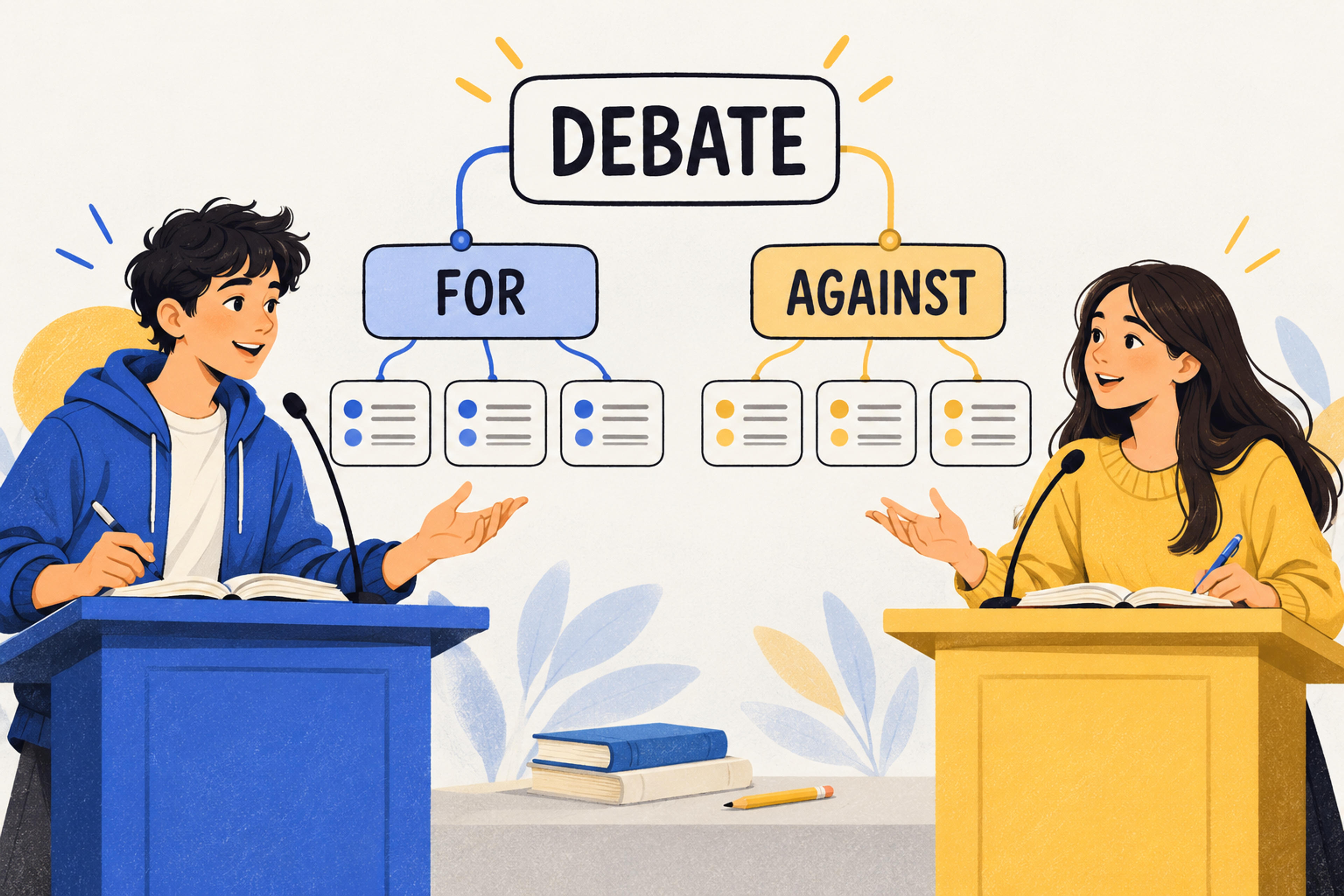
Find a classroom-ready debate topic, explore both sides, and build a clear case with a worked example and preparation template.
A good debate topic gives both sides something worth defending. For students, the strongest starting points are usually decisions they can picture: whether homework should be optional, phones should stay outside classrooms, or schools should replace exams with projects.
Below are 30 debate topics for students, each with an argument for and against. Choose a topic that fits your class, then use the worked example and preparation template to turn an initial opinion into a clear case.
The arguments are starting positions for discussion. Build your case by adding evidence, explaining the reasoning, and answering the strongest objection.
Start with familiar choices that students can explain through concrete examples. For younger students, ask each side to give one reason, one example, and one response to the other team.
| Debate topic | Argument for | Argument against |
|---|---|---|
| 1. Should students choose their own classroom seats? | Students can choose a place where they feel comfortable asking questions and doing their work. | A teacher can arrange seats to support students who need help seeing, hearing, or concentrating. |
| 2. Should every school day include time for free reading? | Students get a regular chance to discover books they enjoy, even when reading time at home is limited. | A fixed reading period takes time from other lessons, and some students need guided reading support instead. |
| 3. Should classes keep a pet? | Sharing responsibility for feeding and care gives students a practical way to learn about animals. | Animal care continues during holidays, and allergies or classroom noise can make a pet unsuitable. |
| 4. Should students be allowed to redo assignments? | A second attempt lets students use feedback and demonstrate what they have learned. | Unlimited redos can make deadlines less meaningful and create extra marking work for teachers. |
| 5. Should schools hold outdoor lessons every week? | Outdoor spaces give students real objects and environments to observe in subjects such as science and art. | Weather, accessibility, and suitable space can make a weekly requirement difficult to meet. |
| 6. Should birthdays be celebrated during class time? | A short shared celebration can help each student feel included in classroom life. | Frequent celebrations interrupt lessons and can create pressure to bring food or gifts. |
Try this first: Use the seating question for a short practice round. Define whether students may change seats daily or choose a seat for the whole term; those are different proposals.
These questions introduce tradeoffs between student choice, fairness, school resources, and shared rules. Before the debate, have both teams agree on exactly who the proposed rule would affect.
| Debate topic | Argument for | Argument against |
|---|---|---|
| 7. Should homework be optional in middle school? | Students could focus their study time on the subjects where they need the most practice. | Students who need practice may skip it, leaving teachers with fewer ways to spot misunderstandings between lessons. |
| 8. Should schools require uniforms? | A common dress standard can reduce pressure to display expensive clothing and make expectations clearer. | Families must buy specific clothing, and students lose a way to express their preferences. |
| 9. Should students help decide how a school activity budget is spent? | Students can identify activities they value and practice making decisions within a real spending limit. | A majority may favor popular activities while overlooking smaller groups or essential expenses. |
| 10. Should schools remove individual rankings from report cards? | Students could focus on their own progress rather than their position relative to classmates. | Rankings give students and families an additional way to understand performance within a cohort. |
| 11. Should all students join at least one school club? | A requirement gives students a reason to try an activity they might otherwise avoid. | Students with transport problems, caring responsibilities, or outside commitments may struggle to participate. |
| 12. Should students be allowed to listen to music during independent work? | Students could choose an environment that helps them settle into individual tasks. | Headphones can make it harder to hear instructions, and preferred music may compete with the task for attention. |
For topic 9, give the class a fictional $500 activity budget. Ask each team to explain how its decision process would represent students whose first choice does not win. The invented budget is a practice constraint, not a claim about school spending.
High school debates can examine policies with more complex consequences. Narrow the proposal enough that teams can compare a specific change with the current approach.
| Debate topic | Argument for | Argument against |
|---|---|---|
| 13. Should high schools replace final exams with projects? | Projects let students demonstrate planning, application, and revision over time. | Project grades can reflect access to outside help and resources, making individual understanding harder to compare. |
| 14. Should high schools start one hour later? | A later start gives students a different sleep and morning travel schedule that could better fit their needs. | Moving the timetable affects buses, after-school jobs, sports, and family arrangements. |
| 15. Should community service be required for graduation? | Every student would have a structured opportunity to contribute beyond the classroom. | Compulsory service adds a graduation barrier for students with limited time or transport. |
| 16. Should schools keep student phones outside classrooms during lessons? | Removing phones makes a shared expectation easier to enforce and reduces opportunities for unrelated use. | Phones can support accessibility, translation, and teacher-directed learning, so a blanket rule needs exceptions. |
| 17. Should students evaluate their teachers at the end of each course? | Students can describe whether instructions, feedback, and classroom routines helped them learn. | Ratings may reflect popularity or dissatisfaction with grades rather than the quality of teaching. |
| 18. Should personal finance be a required high school course? | Every graduate would study practical decisions such as budgeting, borrowing, and comparing costs. | A new requirement can crowd out electives, and schools could teach those skills within existing subjects. |
Make the clash precise: For the later-start topic, both teams should use the same proposed start time. The central question is whether the educational case for changing the schedule outweighs the disruption and cost of changing it.
Technology topics become easier to debate when they name a particular use. “Is AI good?” is too broad. A rule about using AI to brainstorm an essay gives both teams a decision to defend.
| Debate topic | Argument for | Argument against |
|---|---|---|
| 19. Should students be allowed to use AI to brainstorm essay ideas? | Students can explore possible angles and then choose and develop an argument of their own. | Generating initial ideas is part of the learning task, and outsourcing that stage can narrow independent thinking. |
| 20. Should schools require students to disclose AI assistance? | Disclosure helps teachers understand how the work was produced and discuss appropriate use. | The boundary between ordinary software assistance and reportable AI use can be difficult to define consistently. |
| 21. Should schools issue the same laptop to every student? | A common device can simplify technical support and give students access to the same required software. | Purchasing and maintaining devices consumes funding, and one model may not meet every student's needs. |
| 22. Should students have a say in which learning apps a school adopts? | Students can identify confusing features and explain how an app fits actual classwork. | Popularity does not establish educational value, accessibility, or appropriate data handling. |
| 23. Should online courses count toward high school graduation? | Students could access subjects that their own school does not offer. | Schools would need a reliable way to judge course quality, assessment, and student support. |
| 24. Should schools teach coding as a required subject? | All students would get an introduction to making software and solving problems through explicit instructions. | A universal requirement takes time from other subjects and may be less useful than broader digital literacy. |
For an AI debate, specify the allowed task, the disclosure rule, and what the student must produce independently. Those details prevent one team from defending brainstorming while the other argues against submitting an entirely generated essay.
These topics suit high school students, college discussion groups, and mixed-age clubs with time for research. Ask teams to identify who pays, who benefits, and what would happen without the proposal.
| Debate topic | Argument for | Argument against |
|---|---|---|
| 25. Should school cafeterias serve only vegetarian meals one day a week? | A shared menu gives the school a defined opportunity to introduce meals centered on plant-based ingredients. | A compulsory menu reduces choice and may not suit every student's dietary needs or preferences. |
| 26. Should public transport be free for students? | Removing fares makes travel to classes, libraries, and activities more accessible. | The service still needs funding, and targeted discounts may direct limited money toward students who need it most. |
| 27. Should schools replace some parking spaces with gardens? | A garden creates space for outdoor learning and student projects. | Removing parking can make access harder for staff and families where transport alternatives are limited. |
| 28. Should school events stop selling single-use plastic water bottles? | Refill stations and reusable bottles offer a concrete way to reduce discarded packaging at events. | Organizers must provide convenient drinking water for visitors who arrive without reusable bottles. |
| 29. Should a city spend more on bike lanes than new parking? | Bike lanes give residents another way to make local journeys and allocate road space beyond cars. | Residents who depend on driving may need parking more urgently, particularly where distances are long. |
| 30. Should the school library stay open in the evening? | Students would have additional access to a quiet study space, books, and shared equipment. | Longer hours require staffing, security, and transport arrangements that may compete with daytime services. |
For a lighter warm-up, debate the library question using a fictional budget that can fund either two evening openings or extra daytime staff. Giving both sides the same constraint makes the choice more meaningful.
Pick a question with a decision, two defensible positions, and a manageable scope. A useful test is whether you can state the strongest reason for each side without making either sound foolish.
Before choosing, answer four questions:
For classroom discussion, choose policies and ideas students can challenge without requiring classmates to defend their own identity or disclose personal experiences. The aim is to test reasoning through a shared question.
Take topic 7: Should homework be optional in middle school? Narrow it to this practice motion: “Middle schools should make routine practice homework optional, while keeping major assignments required.”
That wording matters. The proposition does not remove every deadline, and the opposition must answer the actual policy rather than a broader ban on schoolwork at home.
Claim: Students should have more control over routine practice.
Reasoning: Students do not all need the same amount of repetition. Someone who has mastered a skill could use that time on a weaker subject, while another student could keep practicing with teacher guidance.
Evidence to find: Look for research that distinguishes homework by age, subject, purpose, and amount. For a local discussion, ask how teachers currently decide which practice to assign. A class survey can describe classmates' experiences, but it cannot establish a universal effect on learning.
Likely objection: Students who need practice may choose not to do it.
Response: Propose short classroom checks and teacher recommendations so optional practice is connected to demonstrated understanding. Then explain whether those checks are practical within lesson time.
Claim: Required practice gives teachers and students a consistent routine for identifying gaps.
Reasoning: Students may not recognize what they have misunderstood until they attempt a task on their own. An optional system depends on students accurately judging their needs.
Evidence to find: Investigate how practice work is used in the relevant subject and how teachers respond when a student struggles. Evidence about one type of assignment should not stand in for every type of homework.
Likely objection: A shared requirement makes students repeat work they already understand.
Response: Defend targeted assignments or a choice of difficulty levels. Explain why changing the assignment is preferable to making participation optional.
Both sides can agree that practice has a role. Their disagreement is about who should decide when practice is needed and how reliably that decision can be made.
A strong closing compares those alternatives directly. It explains why one approach better supports learning under the conditions the teams have defined.
Copy the following into your notes. Complete it for both sides before writing your opening speech.
Debate motion:
Our side: For / Against
People affected:
Exact proposed change:
Key terms and exceptions:
Main test for deciding the debate:

Argument 1:
Claim:
Reason this claim follows:
Evidence, source, and date:
Why the impact matters:

Argument 2:
Claim:
Reason this claim follows:
Evidence, source, and date:
Why the impact matters:

Strongest opposing argument:
Our response:
What our response does not resolve:
Closing comparison:
Keep evidence attached to the claim it supports. Record who produced it, when it was published, and which group or situation it describes. When a source presents an association, explain what it does and does not show about cause and effect.
For a short classroom exercise, try a 12-minute practice format: two minutes for each opening, one minute for each side's questions, two minutes for each rebuttal, and one minute for each closing. This is a suggested classroom activity; use your teacher's or tournament's rules for an assigned format.
If your assignment includes slides, build them around the decisions the audience needs to follow. A six-slide structure is enough for a short case:
Keep full quotations and detailed research in your preparation notes. On the slides, use concise claims, readable evidence, and source labels so the audience can follow the speech.
With SlidesPilot's text-to-PPT converter, you can turn prepared debate notes into a structured presentation. Paste your motion, position, arguments, evidence, and rebuttal, then specify the audience and desired length.
For example, use this instruction with your completed notes:
Create a six-slide debate presentation for a middle school class using the notes below. Our position supports optional routine homework. Include the motion, scope, two arguments, the strongest counterargument with our response, and a closing comparison. Keep source names and dates beside the claims they support. Use only the supplied evidence for factual claims.
Want to organize the comparison before building slides? Sketch one column for each side, then connect each claim to its evidence and likely rebuttal. That makes gaps in your case easier to spot.
Start with a familiar, narrow choice: student-selected seats, assignment redos, required uniforms, or music during independent work. Ask each speaker to provide a reason and example, then answer one specific point from the other side.
Try “Should a class choose its own field trip?”, “Should school lunch include a student-designed menu?”, or “Should every classroom have a reading corner?” Agree on a budget or time limit so each side has a real tradeoff to discuss.
A question is too broad when teams can discuss unrelated issues without meeting each other's arguments. Replace “Is technology good for education?” with “Should students be allowed to use AI for essay brainstorming?” The narrower question identifies a use and a decision.
Look for the strongest concern about the proposed change: cost, access, enforcement, fairness, or an unintended consequence. You can defend an assigned side by examining its reasoning without claiming it represents your personal beliefs.
For a short classroom speech, prepare two well-developed arguments and a response to the strongest objection. Fit the number to the time available: each argument needs room for a claim, evidence, explanation, and impact.
Choose one of these debate topics for students, define the motion, and complete the preparation template for both sides. Once your case is ready, turn the notes into slides for a clear classroom presentation.
Bring your motion, arguments, evidence, and rebuttal into SlidesPilot to create a structured debate presentation.