

Event Proposal Template and Example (Plus a Pitch Deck Outline)
Build an event proposal with a clear approval request, itemized budget, and delivery plan, then use the same example to structure your pitch deck.
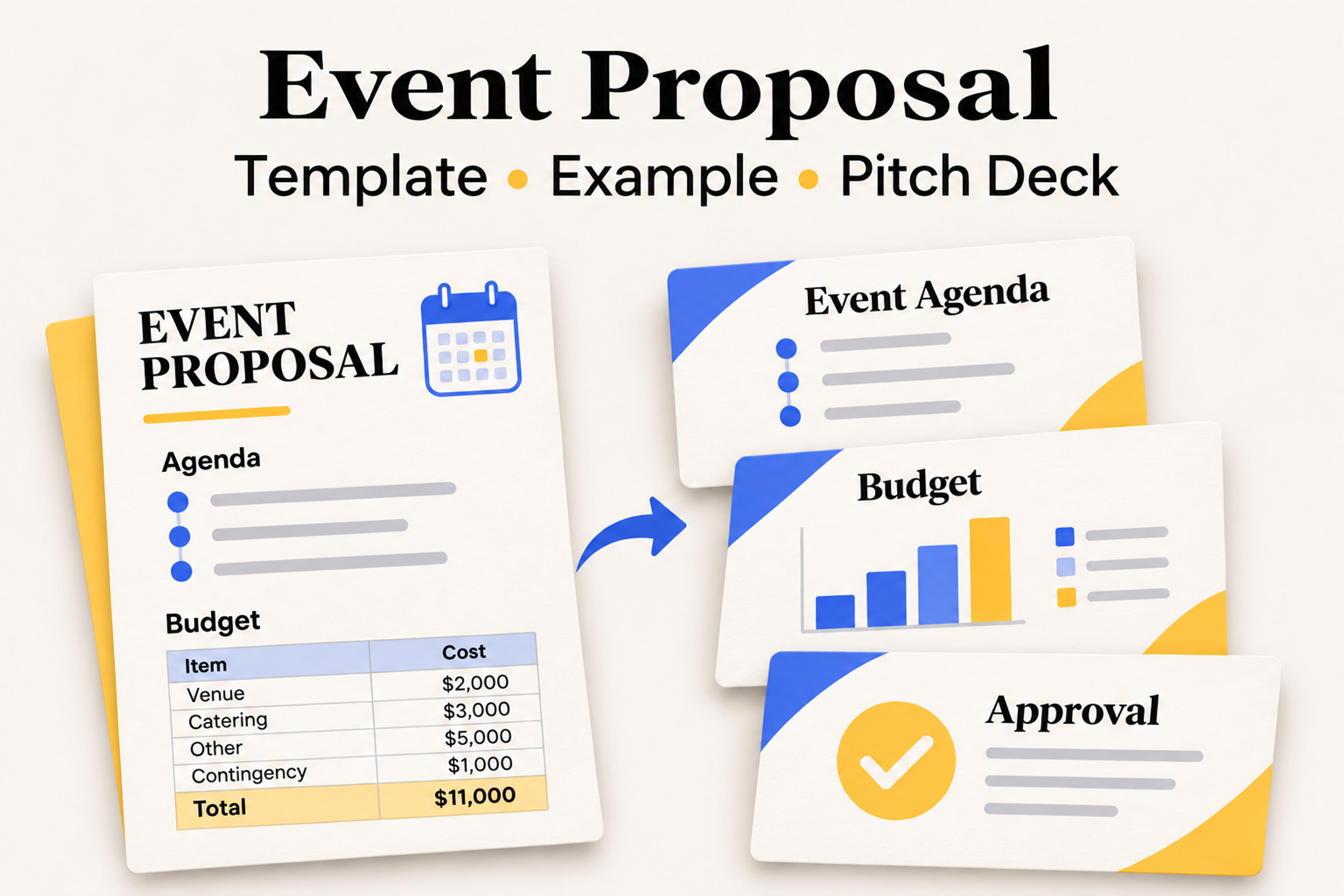
Build an event proposal with a clear approval request, itemized budget, and delivery plan, then use the same example to structure your pitch deck.
An event proposal explains what you want to organize, why it matters, what it will cost, and what you need the reader to approve. A useful proposal gives a client or stakeholder enough detail to make that decision, including the event concept, audience, schedule, budget, responsibilities, and next steps.
Use the event proposal template below to build your document. Then follow the completed example and seven-slide outline to turn the same plan into a pitch deck.
Copy these fields into a Word document and replace the brackets with your event details. Put the approval request near the beginning so readers understand the decision before reviewing the supporting information.
| Section | What to write |
|---|---|
| Event name and owner | [Event name], prepared by [name/team] for [client or approving stakeholder], dated [date]. |
| Approval requested | Approve [amount, concept, or scope] by [deadline] so [next planning action] can begin. |
| Purpose and objectives | We propose [event] to help [audience] achieve [outcome]. Success will be measured by [metric and target]. |
| Audience and attendance | Invite [audience], expect [attendance], and explain the basis for that estimate. |
| Event concept | Describe the theme, format, main activities, and experience attendees will have. |
| Date, venue, and agenda | Give the proposed date, location or platform, duration, and main agenda items. State which arrangements are confirmed. |
| Scope and responsibilities | List the work included, who owns each part, and any services that require a separate agreement. |
| Planning timeline | Show the approval deadline, booking milestones, invitation launch, and final readiness check. |
| Budget and funding | Itemize estimated costs, funding sources, contingency, and the total amount requested. |
| Risks and contingencies | Identify the few risks that could change delivery and the action planned for each. |
| Measurement and follow-up | Explain how results will be collected, who will report them, and when. |
| Next steps | Name the approver, the response needed, and the first action after approval. |
For an agency proposal, add your relevant experience, team, service fees, and commercial terms. If you are responding to an RFP, follow its requested order and supply each required item.
This fictional event proposal sample shows how those fields work together. All names, dates, costs, and targets are illustrative planning assumptions.
Event name — Customer Operations Exchange 2027
Prepared for — Northstar Software's Head of Customer Success and Finance Director
Prepared by — Customer Marketing Team
Proposed date — April 22, 2027, from 9 a.m. to 1 p.m.
We request approval for a customer workshop with a maximum budget of $11,000 by February 19, 2027. Approval will allow the team to request final venue quotes and begin booking a suitable space. The proposed venue is a local hotel meeting room with capacity for 60 attendees. Availability and pricing remain provisional.
The workshop will help customer operations managers improve their onboarding processes through a practical session and peer discussion. We plan to invite 120 contacts from existing customer accounts, with a target of 40 attendees. The attendance target is an assumption for this example.
The event has three measurable targets. Reach 40 attendees, collect at least 25 completed feedback forms with an average usefulness rating of 4 out of 5, and secure 10 opt-in follow-up meetings within two weeks. The Customer Marketing Team will track attendance and feedback. Customer Success will manage follow-up requests.
The event combines a short customer story, a guided workshop, and facilitated discussion. Attendees will leave with an onboarding action plan they can take back to their teams.
| Time | Activity | Intended result |
|---|---|---|
| 9–9:30 a.m. | Arrival, breakfast, and introductions | Help attendees meet peers and share their priorities. |
| 9:30–10 a.m. | Customer onboarding case example | Establish a concrete problem for the workshop. |
| 10–11 a.m. | Guided process-mapping workshop | Draft an onboarding improvement plan. |
| 11–11:15 a.m. | Break | Allow time for informal discussion. |
| 11:15 a.m.–12 p.m. | Facilitated peer discussion | Compare approaches and gather feedback. |
| 12–1 p.m. | Lunch, action commitments, and feedback | Record next steps and offer follow-up meetings. |
The Customer Marketing Team will own the venue, invitations, registration, signage, and feedback survey. Customer Success will select the customer example and facilitate discussions. A contracted workshop facilitator will lead the process-mapping session. Finance will review spending before bookings are confirmed.
The proposed scope covers one local workshop. Travel, overnight accommodation, and a live broadcast would require additional planning and funding.
| Deadline | Milestone | Owner |
|---|---|---|
| February 19 | Approve the concept and budget ceiling | Head of Customer Success and Finance Director |
| March 5 | Confirm venue and facilitator | Customer Marketing |
| March 12 | Send invitations and open registration | Customer Marketing |
| April 8 | Review registrations and adjust outreach | Customer Marketing and Customer Success |
| April 15 | Complete the agenda and venue readiness review | Event team |
| April 22 | Deliver the workshop | Event team |
| May 6 | Report results and follow-up meetings | Customer Marketing and Customer Success |
The budget assumes 40 attendees and up to 10 staff or facilitators, with catering for 50 people. The venue must accommodate up to 60 people. All amounts are in USD, with taxes and fees included in the illustrative estimates.
| Item | Calculation | Estimated cost |
|---|---|---|
| Meeting room | Half-day room hire | $2,000 |
| Catering | 50 people × $60 | $3,000 |
| Audiovisual equipment | Screen, microphones, and support | $1,000 |
| Workshop facilitator | Preparation and delivery | $2,000 |
| Materials and signage | Workbooks, badges, and signage | $500 |
| Event staffing | Allocated staffing cost | $1,500 |
| Base budget | Sum of the six categories | $10,000 |
| Contingency | 10% of the base budget | $1,000 |
| Total proposed budget | Base budget plus contingency | $11,000 |
The team proposes funding the event from the customer marketing budget. Use of the $1,000 contingency requires the Finance Director's written approval. Spending above $11,000 requires a revised proposal.
If the preferred room is unavailable, the team will request an alternative venue quote within the approved ceiling. If registrations are below 25 on April 8, Customer Success will prioritize direct outreach to invited accounts. The team will confirm accessibility, dietary requirements, and audiovisual needs during registration and the venue review.
Please approve the workshop concept and maximum spending ceiling by February 19. Customer Marketing will then obtain final quotes, confirm the delivery team, and submit booking commitments for approval. (End of example proposal)
Upload your Word proposal to create an editable slide deck for your client or stakeholder meeting.
Create My Event Proposal DeckStart by naming the decision-maker and the action you need. A client choosing an event agency will want evidence of delivery experience and a clear service scope. An internal budget owner will want to understand the expected outcome, cost, and responsibility for delivery. Use that difference to decide what deserves the most space.
Write the approval request before expanding the concept. If you cannot complete the sentence “Please approve ___ by ___ so we can ___,” clarify the scope before adding more detail.
Next, connect each major activity to an objective. In the example, the workshop produces an action plan, while the final session collects feedback and follow-up requests. That connection gives the reader a reason to fund each part of the agenda.
Build the budget from quantities and assumptions. A line such as “catering, $3,000 for 50 people” gives the approver a way to assess the estimate. State how contingency is calculated and who can authorize its use. Keep the approval request consistent with the budget total.
Finally, read the proposal as if you were approving it. Make sure attendance assumptions match the catering and venue capacity, milestones leave time for booking and invitations, and the named owners can perform the work. Finish with a dated request and a clear next action.
Once the written event proposal is ready, build the presentation around the approval conversation. Keep the detail that helps your audience decide, and place supporting quotes or operational notes in an appendix.
| Slide | Main message for the example | What to show |
|---|---|---|
| 1. Approval request | Approve a customer workshop with a $11,000 ceiling by February 19. | Event name, proposed date, and the decision requested. |
| 2. Goals and audience | Help customer operations managers improve onboarding. | Audience, 40-attendee target, feedback target, and follow-up target. |
| 3. Event concept | A practical half-day workshop will produce an action plan. | The four-hour agenda and attendee takeaway. |
| 4. Delivery plan | The team has named owners and dated milestones. | A short planning timeline with the booking and invitation dates. |
| 5. Budget | Approve the $11,000 proposed budget. | $10,000 base cost and $1,000 contingency. |
| 6. Risks and contingencies | Venue and attendance assumptions have defined responses. | The main risks, planned actions, and responsible team. |
| 7. Decision and next steps | Approval releases final quoting and booking work. | Approvers, February 19 deadline, and the first planning action. |
To create the deck from your document, upload your DOC or DOCX file to SlidesPilot's Word to PPT converter. Specify the audience, the approval you want, and the sections to emphasize. SlidesPilot uses the document's structure to organize an editable presentation that you can refine and export to PowerPoint.
You can use this instruction with your own proposal.
Create a seven-slide event proposal presentation for the budget owner. Lead with the approval request and deadline. Include the audience, measurable goals, event concept, delivery timeline, budget, risks, and next steps. Preserve the supplied figures and show the base cost and contingency separately.
Give the written proposal and deck a final consistency check. The event name, date, audience, attendance estimate, budget, and approval request should agree across both. If the recipient supplied an RFP or submission instructions, confirm that your response includes every requested attachment and follows the required format.
Send the proposal to a named decision-maker with a short message stating the decision needed and response date. For a presentation meeting, share the document in advance so attendees can review the detailed estimates before discussing the slides.
Include the event purpose, audience, concept, date and venue, agenda, scope, planning timeline, budget, delivery team, risks, and approval request. Add experience and service terms when pitching event planning services to a client.
Use the length needed to support the decision and meet the recipient's instructions. A small internal workshop can use a concise document. An agency response with venue options, supplier quotes, and commercial terms will need more detail. Put the request and key figures first, with supporting material in an appendix.
A sponsorship proposal also needs to explain the audience a sponsor will reach, the benefits included, the contribution requested, the deliverables, and how results will be reported. Develop those details around the sponsor's objectives.
Yes. A slide deck helps you walk stakeholders through the concept, costs, and decision. Keep the written proposal available for detailed scope and estimates. If your proposal is already in Word, use SlidesPilot to turn the document into PowerPoint. For a proposal saved as plain text, you can start with Text to PPT.
Upload your Word proposal to create an editable slide deck for your client or stakeholder meeting.

