

10 Fun Biology Topics That Make Great Presentations
Find a biology topic worth explaining, then turn it into a focused presentation with a clear question, useful visuals, and a six-slide outline.
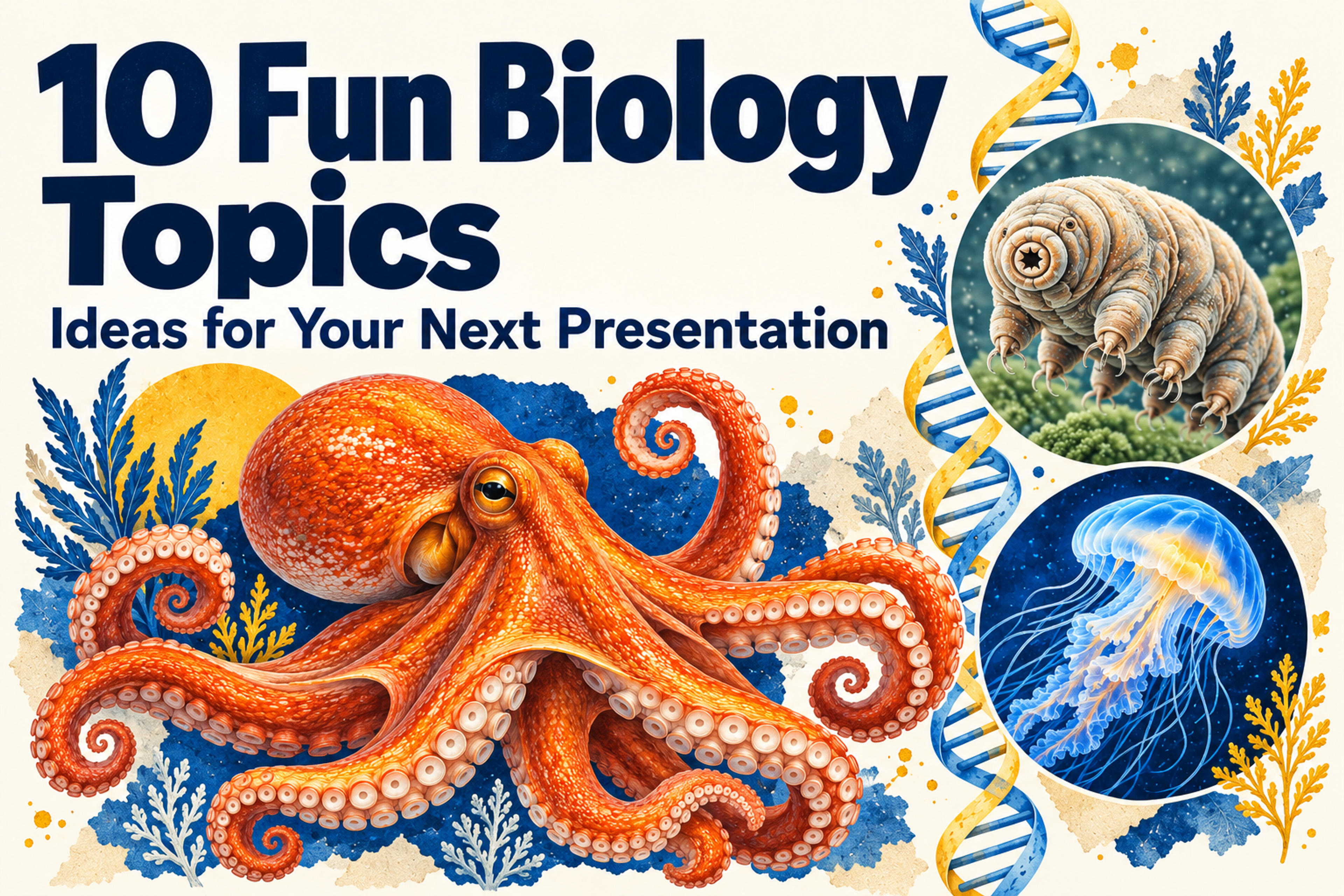
Find a biology topic worth explaining, then turn it into a focused presentation with a clear question, useful visuals, and a six-slide outline.
An octopus changing color, a tiny animal surviving dehydration, and yeast making bread rise all have something in common: each turns a biological process into a question you want answered.
If you’re looking for fun biology topics for a presentation, essay, or class discussion, start with a phenomenon you can show. Then choose one question about how it works. Bioluminescence, camouflage, regeneration, and fermentation offer clear entry points; epigenetics and CRISPR give you room for a more advanced explanation.
Below are ten ideas, with a focused question and a visual approach for each.
A glowing organism is an immediate attention-grabber. The explanation is just as interesting: bioluminescence produces light through a chemical reaction within a living thing. Different organisms use that light for feeding, defense, or communication. Some marine animals even use light on their undersides to make their silhouettes harder to detect from below. Smithsonian Ocean
Build your talk around one function. For example, ask how producing light could help an animal hide. That question creates a useful puzzle before you introduce counterillumination.
Visual idea: Draw an animal viewed from below, first as a dark silhouette against the brighter surface and then with its underside illuminated.
An octopus can change its visible color patterns using pigment-containing structures called chromatophores. Muscles expand these structures, making their pigment more visible. This connects an impressive whole-animal behavior to structures in the skin. Smithsonian’s explanation of color change
Ask your audience to find a camouflaged octopus in an image before explaining the mechanism. Then move from the whole animal to a close-up diagram. The change in scale helps the audience understand how many small structures contribute to a larger pattern.
Visual idea: Pair two photographs with a simple diagram of contracted and expanded pigment sacs. Label the diagram separately from the photographs.
Tardigrades are microscopic animals often called water bears. Some can enter a highly dehydrated state in which metabolism becomes nearly undetectable. This state, called anhydrobiosis, helps them survive conditions they could not tolerate while active. NASA describes this ability in its tardigrade research materials. NASA tardigrade overview
The strongest presentation question is “How does dormancy change survival?” Compare an active tardigrade with its contracted dormant form, called a tun. Keep the distinction between surviving a condition and actively living in it central to your explanation.
Visual idea: Show an active–dormant–rehydrated sequence, with water availability marked beneath each stage.
Choose a topic, add your source notes, and use SlidesPilot to create a presentation you can refine.
Create My Biology PresentationAxolotls can regenerate limbs. In salamanders, regrowth involves a structure called a blastema, where dividing cells contribute to the replacement tissues. Humans also repair and replace some tissues, but cannot regrow a whole limb. NIGMS on regeneration
Use this topic to explore an organizational problem: a limb needs multiple tissues arranged in the right places. A useful talk can explain why replacing a complete structure is more demanding than simply producing more cells.
Visual idea: Create a simplified sequence showing an injury, blastema formation, and limb regrowth. Label it as a conceptual diagram rather than an exact timeline.
A nerve cell and a muscle cell perform different jobs even though their nuclei generally contain essentially the same genome. One part of the explanation is gene regulation. Epigenetic marks help influence how cells use DNA without changing its underlying sequence. NHGRI’s epigenomics fact sheet
Start with the difference between having an instruction and using it. Then introduce chemical marks and DNA-associated proteins as part of the machinery that regulates gene activity. Keep the focus on cell specialization so the talk has one clear problem to solve.
Visual idea: Show the same simplified set of genes in two cells, highlighting different active groups. Describe the illustration as a model of gene use.
Circadian rhythms are biological changes that follow roughly a 24-hour cycle. Light and darkness strongly influence them, and they affect functions including sleep patterns, hormone release, digestion, and body temperature. NIGMS on circadian rhythms
Jet lag provides a familiar starting question: what happens when your surroundings move to a new schedule before your internal timing catches up? Use that example to introduce the relationship between internal clocks and environmental signals.
Visual idea: Put the destination’s day–night cycle above a traveler’s previous schedule. Use the mismatch to explain the problem, without assigning everyone identical sleep times.
Bread offers a biology lesson you can see. Yeast is a single-celled fungus that can ferment sugars, producing carbon dioxide and alcohol. Gas trapped in the dough helps it rise. Institute of Food Science and Technology
For a presentation, follow the carbon dioxide from yeast activity to the pockets inside dough. For a class investigation, frame a question about one variable, such as temperature, using your teacher’s approved method. Explain what you would measure and which conditions you would keep constant.
Visual idea: Combine photographs of dough before and after rising with a close-up sketch of trapped gas pockets.
Corals host microscopic algae in their tissues. These partners provide a major food source and contribute to coral color. Stress can disrupt the relationship and cause corals to lose the algae, leaving them pale or white. Bleaching does not mean a coral is already dead, although prolonged stress can be fatal. NOAA on coral bleaching
This topic connects a visible environmental change to a biological partnership. Organize the explanation around the relationship first, then show what changes during bleaching.
Visual idea: Draw healthy and bleached coral tissue side by side, showing the presence or loss of algae. Include recovery and continued stress as possible outcomes.
Bioluminescence and fluorescence can look similar in photographs, but their energy sources differ. Fluorescence absorbs incoming light and re-emits light at a different wavelength. Bioluminescence gets its light-producing energy from a chemical reaction inside an organism. UC Santa Barbara’s bioluminescence resource
Make this a comparison talk. Begin with two images that appear to show glowing organisms, then ask what information you need about the lighting conditions to explain each one.
Visual idea: Use two arrow diagrams: incoming light → fluorescent material → emitted light, and chemical reaction → emitted light. This gives the audience a distinction they can apply to other examples.
CRISPR technology allows researchers to selectively modify DNA. It was adapted from naturally occurring systems found in bacteria. That origin makes it a useful topic for connecting basic biology to biotechnology. NHGRI’s CRISPR definition
For an advanced presentation, narrow the question to how a CRISPR-Cas system targets a DNA sequence. Explain the roles of the guide and the DNA-cutting protein before moving to an application. Give the mechanism enough space that the audience can follow the later discussion.
Visual idea: Use a conceptual sequence showing a guide locating a matching target and a Cas protein acting at that site. Follow it with one clearly sourced application.
Once you have a topic, write the question your presentation will answer in one sentence. Use that question to decide what belongs in the talk.
A short presentation can follow this six-slide structure:
For a talk on bread, that becomes: rising dough, yeast and sugars, fermentation, an observation of gas production, the connection to food production, and an explanation of why dough expands. Each slide answers part of the same question.
Keep the evidence visible. A photograph shows appearance; a diagram explains a proposed or established mechanism; a graph shows measurements. Give each visual a caption that tells the audience what it demonstrates.
Gather your chosen question, source notes, and outline before creating the deck. SlidesPilot’s AI presentation generator can turn a topic or source material into a presentation you can refine.
For example, use this prompt:
Create a six-slide biology presentation for high school students answering “How does yeast make bread dough rise?” Use the supplied source notes. Include essential vocabulary, a fermentation diagram, one observation, and a final explanation with source references.
Choose the fun biology topic you most want to explain, narrow it to one question, and build the presentation around the moment your audience understands the answer.
Bring your question, source notes, and outline to SlidesPilot to create your first slide draft.