

How to Create a Thesis Defense Presentation from Your Research Paper
A research-backed, slide-by-slide guide to turning a thesis or research paper into a clear, credible, and editable defense presentation.
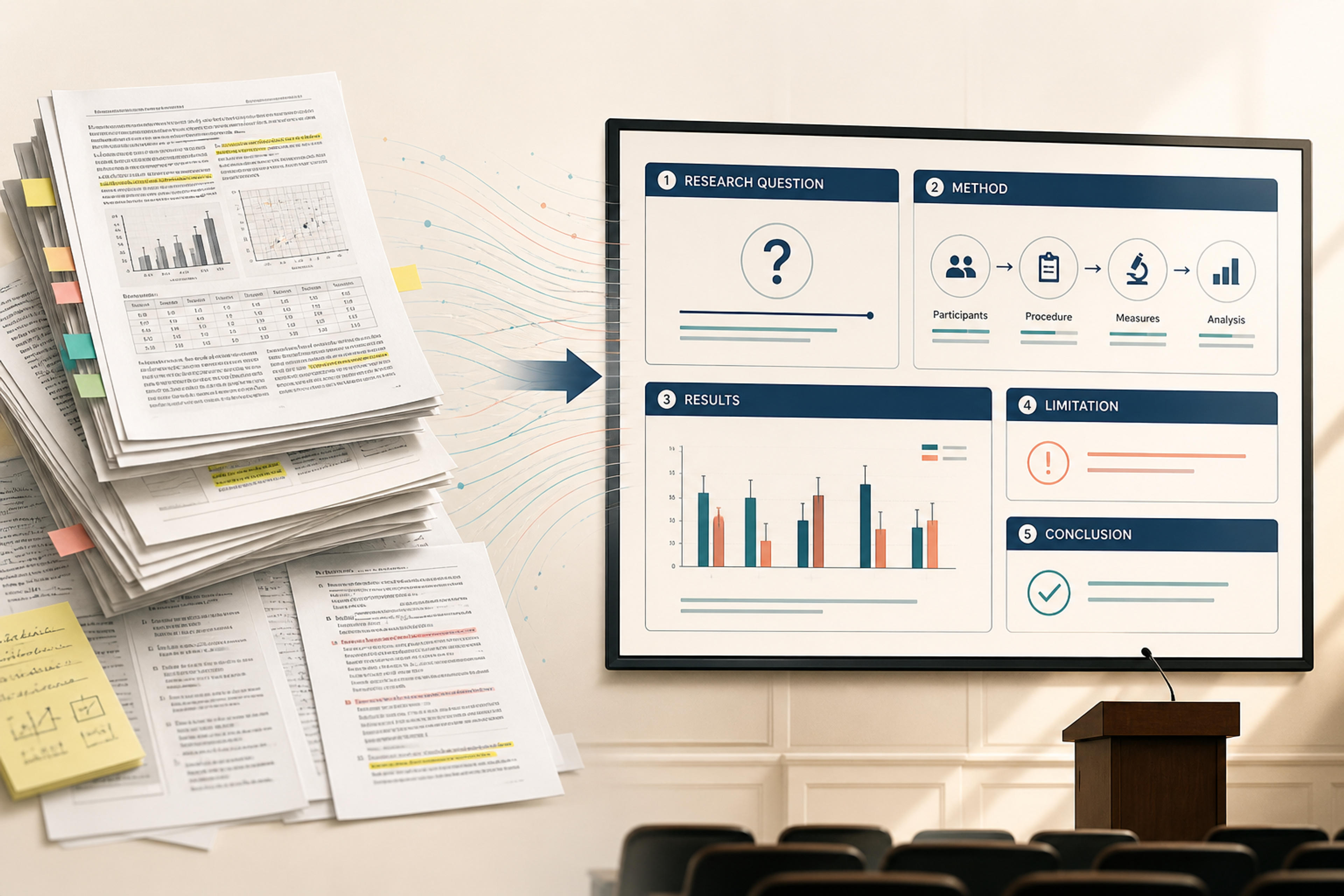
A research-backed, slide-by-slide guide to turning a thesis or research paper into a clear, credible, and editable defense presentation.
A thesis defense presentation should not be a compressed version of your dissertation. It should be a carefully argued answer to four questions: What problem did you study? Why does it matter? What did you discover? Why should the committee trust the contribution?
That distinction changes the whole deck. A dissertation is designed to preserve the complete record of the research. A defense is designed to help a room of people understand, test, and discuss its central contribution within a fixed amount of time.
The strongest workflow is to begin with the thesis, extract one defensible claim, build a narrative around the evidence for that claim, and move technical detail that supports—but does not advance—the story into backup slides.
Your committee has already received the written thesis. They do not need every paragraph retold on slides. The presentation has a different job:
MIT's thesis-defense guidance recommends a clear progression from background and problem to approach, results, and conclusion. Its communication guidance goes one step further: define the central message first and use results as evidence for it, rather than treating the talk as a tour through every chapter. That is a useful test for every slide. If it does not help the audience understand or evaluate the contribution, it probably belongs in the appendix.
Before opening PowerPoint, finish this sentence:
This thesis shows that [main finding or contribution], using [approach or evidence], which changes how we understand or address [larger problem].
This is not necessarily the wording you will put on the title slide. It is the decision rule for the entire presentation.
Suppose a thesis contains three studies on sleep, device use, and academic performance. A weak organizing statement would be: “This dissertation examines sleep and technology among university students.” It names a field but does not state a contribution.
A stronger version would be: “Across two student cohorts, late-night device use was associated with shorter sleep and lower next-day performance, identifying schedule design as a practical intervention point.” Now the audience can anticipate the logic of the talk: why the problem matters, how the cohorts were studied, what the evidence showed, what the analysis can and cannot establish, and what should happen next.
If you cannot write this sentence yet, the deck is not ready to be designed.
Most research defenses can be organized into four phases:
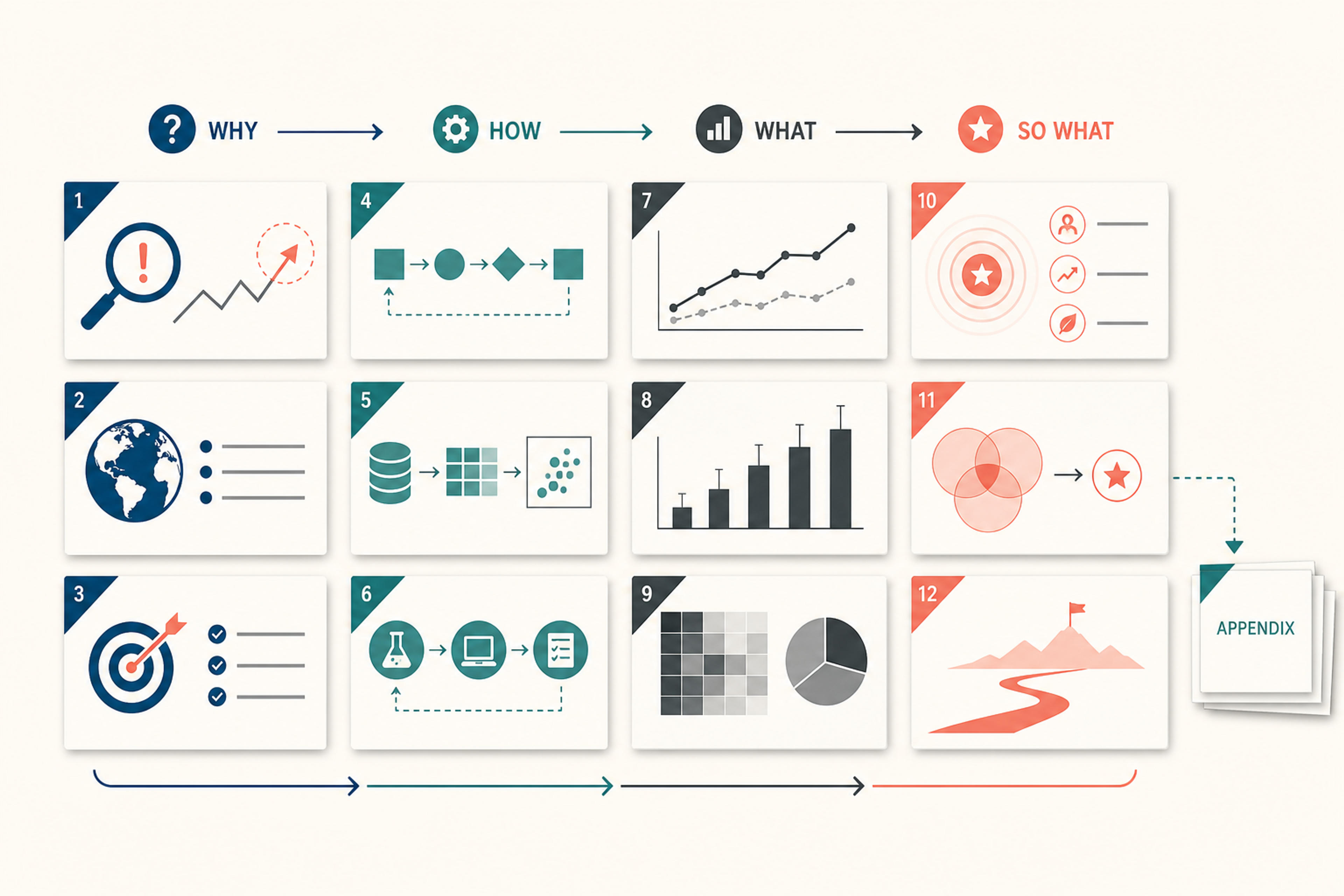
This structure is more useful than copying the dissertation table of contents because it follows the questions forming in the audience's mind. It also works for both monograph and article-based theses. If the thesis contains several distinct studies, repeat a smaller question–method–finding–takeaway sequence inside the larger story, then reconnect the studies in the synthesis.
The exact length depends on your program and discipline. Some defenses allow a 20-minute opening talk; others expect 45–60 minutes followed by public and committee questions. Always confirm the local rules before deciding the slide count.
The following 12-slide core is a useful starting point, not a quota:
| Slide | Purpose | What belongs on it |
|---|---|---|
| 1. Title and contribution | Orient the room immediately | Thesis title, name, program, and a plain-language subtitle that signals the contribution |
| 2. Why this problem matters | Create stakes | One concrete consequence, observation, figure, or unresolved decision |
| 3. What we know—and do not know | Define the gap | Only the prior work required to understand the missing piece |
| 4. Research question and claims | State what the thesis tests or explains | Primary question, hypotheses or objectives, and the contribution statement |
| 5. Research design | Show the overall logic | Diagram linking studies, data, variables, or stages of inquiry |
| 6. Methods that determine credibility | Explain how evidence was produced | Sample, measures, procedure, model, materials, or interpretive framework |
| 7–9. Key findings | Present the evidence | One finding per slide, with the result in the title and one dominant figure or table |
| 10. Synthesis | Connect the findings | What the studies collectively show and how they answer the research question |
| 11. Limitations and boundaries | Define the reach of the claims | Main constraints, alternative explanations, and what remains unresolved |
| 12. Contribution and implications | Leave a clear final answer | The new knowledge, practical or theoretical implication, and next research step |
Add acknowledgements after the conclusion if your program expects them, and build an appendix for Q&A. For a longer defense, the core expands through additional finding sections and brief transition slides—not by turning every chapter heading into a slide.
Upload it to SlidesPilot and turn the research question, methods, findings, and contribution into a structured, editable thesis defense presentation.
Build My Defense DeckA defense audience is rarely uniform. Committee members know the field, but they may specialize in different methods or subtopics. Other faculty, students, friends, or family may also attend the public talk.
Start at the broadest point everyone needs, then move toward the specialized question. MIT's Biological Engineering Communication Lab suggests working backward through repeated “why” questions until you reach common ground, then presenting those answers in reverse order. This produces a natural path from shared context to the precise research gap.
For example:
The opening does not need a long literature review. It needs the minimum background required for the audience to understand why your question is worth answering.
The literature-review section is one of the easiest places to lose time. A slide containing a wall of citations proves that you have read widely, but it does not show what the literature means.
Instead, organize prior work around a tension:
A strong literature slide can usually be read as a simple argument:
We know A. Evidence for B is mixed. Nobody has tested C under D. Therefore, this thesis asks E.
Keep full references in a small, readable source area or in the appendix, depending on your discipline's conventions. The slide itself should foreground the gap.
The methods section should give the committee enough information to judge whether the findings are credible. It should not reproduce the methods chapter line by line.
Choose the details that materially affect interpretation:
A visual workflow is often better than six method bullets. Show how input became evidence: recruitment to sample, source collection to coding, experiment to measure, or raw data to model and validation. If your thesis contains several studies, begin with a map showing how they relate, then give each study only the method detail needed to understand its result.
Do not title a slide “Results,” “Regression Analysis,” or “Study 2.” Those labels identify a topic but make the audience do the interpretive work.
Write a title that states what the exhibit shows:
Then design the slide around one dominant exhibit. Remove chart elements that do not help the audience see the finding. Label the relevant comparison directly, explain units, and distinguish statistical significance from practical importance. If a figure comes from the thesis, adapt it for projection rather than pasting a publication-sized chart full of tiny labels.
NASA's guide to presenting research emphasizes integrating each result with its meaning. A chart should not be followed by “as you can see.” Tell the audience what changed, what evidence supports the claim, and why that finding matters to the research question.
A serious limitations slide does not weaken the defense. It shows that you understand precisely what the evidence can support.
Useful limitation statements have three parts:
For example:
Device use was self-reported, which may affect estimates of absolute duration. We therefore interpret the analysis around relative patterns and tested whether the main association was stable across alternative thresholds. Passive measurement would be the next validation step.
This is more informative than a generic bullet saying “self-report bias.” It tells the committee that you recognize the issue, understand its effect on the claim, and know how it can be addressed.
Your final slide should answer the research question in language that is both precise and memorable. A good conclusion separates three layers:
Keep this slide visible when questions begin if local practice allows. It gives the discussion a clear anchor and reminds everyone what the thesis is ultimately claiming.
If the written thesis or research paper is complete, you can use SlidesPilot's research paper to PPT workflow to create an editable starting point. The quality of that starting point depends on the brief.
A useful instruction is:
Create a 20-minute thesis defense presentation for a mixed academic audience. Lead with the practical and theoretical importance of the research problem. Build the deck around this contribution: [contribution]. Use the methods only to establish credibility, prioritize these three findings: [findings], include the main limitations, and place technical robustness checks in an appendix. Write slide titles as evidence-based takeaways.
AI is most helpful at the transition from a long document to a presentation outline. Your judgment is still required to decide which claim deserves the stage, how much technical detail the committee needs, and whether each generated statement is supported by the thesis.
Q&A preparation is not a list of random questions. It is a map of where the argument can be tested.
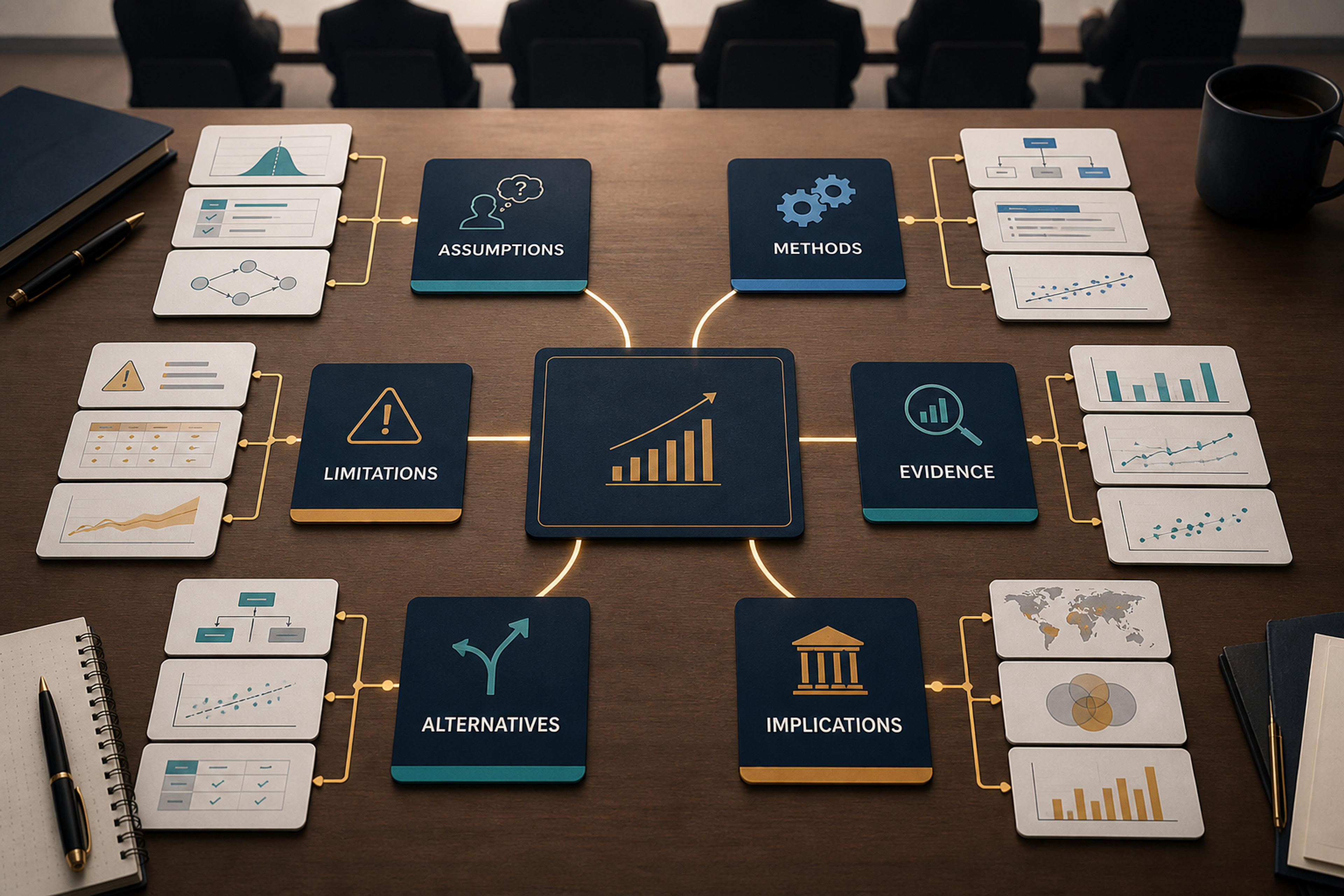
Prepare backup slides in six groups:
Use a short label at the top of every backup slide so you can find it quickly. Hyperlinks from a hidden appendix menu can help in PowerPoint, but a clear numbered appendix is often enough.
When answering, start with a direct one-sentence response. Then give the evidence or reasoning. End by connecting the answer back to the scope of the thesis. If you do not know, distinguish what the current research supports from what would require new analysis. A defense rewards command of the work, not instant certainty about every possible extension.
Run at least three different rehearsals:
Also test the actual room or virtual setup. Confirm aspect ratio, fonts, videos, embedded media, presenter view, remote clicker, microphone, and backup file. Microsoft recommends using readable type, high contrast, concise text, accessible visuals, and a final equipment check; these basics matter even more in a defense because a technical failure consumes the time needed for your argument.
Before you submit or present the deck, confirm that:
There is no universal number because defense formats range from short opening statements to 45–60 minute research talks. Start with the time limit and narrative. A focused 20-minute defense may use about 12–18 core slides; a longer defense may need more finding sections. Prioritize pacing and clarity over a fixed slides-per-minute formula.
Not necessarily. Follow the argument the audience needs: problem, gap, research question, approach, findings, synthesis, limitations, and contribution. An article-based thesis can contain short study-level storylines inside this larger arc.
Include only the prior work needed to establish the problem, the unresolved gap, and the logic of your approach. Keep deeper literature comparisons and full references available for Q&A.
Usually present the core findings and synthesis first, then explain limitations before stating the final bounded contribution. The exact order can vary, but the audience should understand both what the work shows and where the claim stops.
Yes. AI can help extract a narrative, draft an outline, condense source material, and create an editable presentation. You remain responsible for the research claims, citations, figures, interpretation, and any disclosure required by your institution.
The goal is not to make your work look unchallengeable. It is to make the logic visible enough that the committee can engage with the real contribution. A focused story, claim-led results, explicit boundaries, and well-prepared backup evidence create a defense that feels confident because the thinking is clear—not because every detail has been crowded onto the screen.
Turn a research paper into a clear, editable PowerPoint covering the question, methods, results, limitations, and citations.
Turn reports, papers, and documents into clear, structured, editable PowerPoint presentations with AI.
Turn an idea into a complete, structured presentation. Define the audience and goal, guide the tone and length, and let SlidesPilot build the storyline, slide plan, content, and visual direction.
Practical guides for turning documents, ideas, research, and web content into better presentations with AI.
Bring your research paper into SlidesPilot and create a clear thesis defense presentation with your argument, evidence, and contribution organized into a professional, editable deck.
